


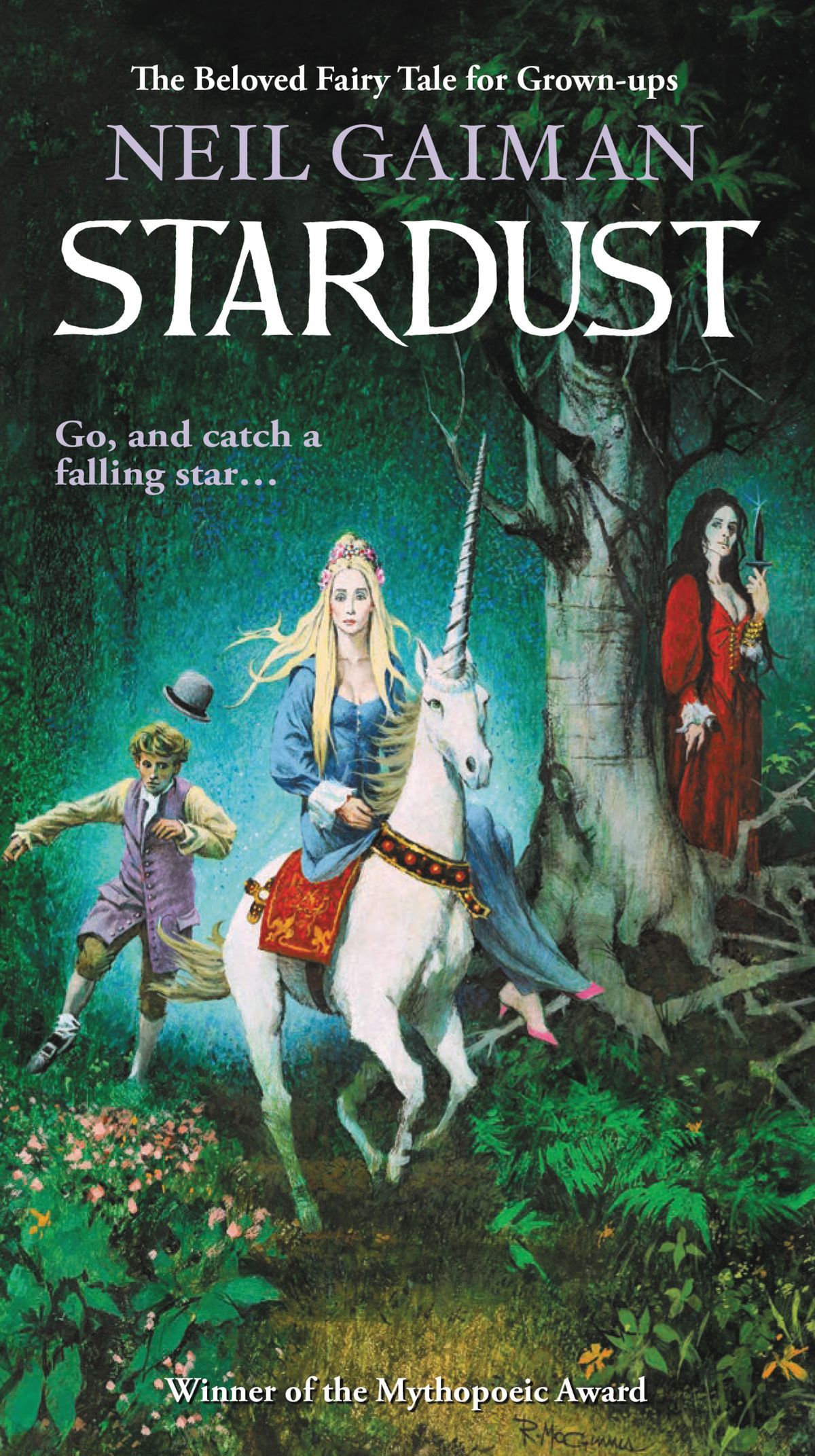
by Neil Gaiman
1998, HarperCollins Publishers
Paperback, 288 pages, $12.50 CAD
Rating: ★☆☆☆☆
I wrote this review prior to Neil Gaiman’s sexual assault allegations, and before J. K. Rowling’s bigotry became apparent to me. In hindsight, it’s funny that I called Gaiman out for his misogyny, though I was still blind to his true nature at time of writing this review.
In my attempt to evaluate the quality of Stardust, I was torn on whether its fairy tale format should come into play when making my final decision. Neil Gaiman makes it clear in his introduction that Stardust was written in the style of fairy tales he was familiar with as a child, and the book’s tagline similarly describes it as a “Fairy Tale for Grown-ups”. And yet, I can’t help but judge it as more than just a fairy tale, even if it never really pretends to be anything but. If experienced only as intended, all of Stardust’s elements are what one would expect from a traditional European folktale. However, I’m not entirely sure if genre faithfulness is enough to excuse its many problematic elements—elements that really shouldn’t have a place in a modern story. I also feel the need to approach the book’s writing at face value. Despite its apparent prestige, there’s a lot therein that embodies the worst of what fairy tales have to offer—including one-dimensional characters, flat exposition, and abrupt shifts in pacing. As I was reading, I found myself making excuses for these issues, with the understanding that the book was simply meant to be a callback. After some reflection though, this isn’t fair to me or writing as a whole, since I have to be able to say whether I enjoyed the experience of reading, rather than whether the book worked as intended.
What stuck with me the most as I was reading were the many problematic elements scattered throughout Stardust. Tristran is a wholly unlikeable protagonist, pulling on the trope of the Stupid but Brave Hero, with a dash of dimwittedness that’s supposed to make him appear charming. I found him annoying and misogynistic, and he never really changes in any meaningful way. Things just happen to him—not as a result of his actions, but just because the story demands it. Rather than him making any meaningful choices or having any kind of agency, the universe just moves him along to the next plot development. Him having magical powers and being revealed as the child of royalty just reinforced how uninteresting his character was from the beginning, since it feels as though he was always going to succeed, regardless of the eventual outcome. Most troubling of all is how he treats women around him—an issue that extends beyond his character to encompass the book as a whole. He either treats every woman he meets as objects, or as tools to get the object-woman that he wants. The only time he has any meaningful interactions with other characters is when they are men. In fact, even though he spends more than half the book with her, I can’t recall him ever having an intimate conversation with Yvaine, even at the end when the two unconvincingly fall in love with each other.
As mentioned, these issues extend beyond Tristran, with the other women in the story—the witches, the one woman on the skyship—being tools without any personality, or there to fulfill the Women with Power are Evil trope, or to further the myth that a woman’s only goal is to be young and sexy. There’s even a troubling amount of scenes in which Gaiman describes female characters in an unnecessarily erotic manner—another problematic trope often seen in books by male authors. In this same vein, it’s also troubling that both Yvaine and Una are salves for the majority of time they are characters in the book. It’s as if it’s not enough that women have no personality or agency in Stardust, they must also be held against their will and forced into servitude for them to be interesting. It’s made worse by the fact that Yvaine and Tristran are involved in an abduction as romance subplot, and that Una’s only way of freeing herself from salvery is to whore herself out to a gullible farm boy.
I could spend a lot more time on exploring Stardust’s problematic elements, but I think I’ve made my point as to why I had a difficult time appreciation it for what it is. It’s a shame because there are certainly moments of brilliance in the book—times where it feels like Gaiman reached beyond the fairy tale format to give us something worth reading. But these moments are few and far in between, to the point I can’t recall any specific examples as I write this review. If it were the case that these problems are inseparable from the fairy tale genre, I think I’d be more willing to excuse how problematic and uninteresting the story is. However, it feels like either Gaiman picked the worst aspects of what makes up a fairy tale, or he missed the mark with Stardust. It ends up feeling like he’s using the genre as an excuse to tell a misogynistic, broken and wholly unappealing boyhood fantasy—something which may have been more difficult to justify in another genre. It really is a wasted opportunity, because I know that modern fairy tales can be better than this. J. K. Rowling’s The Tales of Beedle the Bard is the first example that comes to mind, which utilized the fairy tale format in a much more pleasing way. I’ve been reading more from Neil Gaiman recently, and I have to be honest that Stardust has made me seriously question whether I should continue to read his work in the future, if this is the kind of story he feels worth sharing with the world.
Select a result to preview