


Directed by Jon M. Chu
2024, Universal Pictures
2 hours, 40 minutes
Rating: ★★★☆☆
As the credits rolled on Wicked: Part I, my wife turned to me and asked what I thought. Surprised by the sudden question, my writer brain kicked into high gear and I answered: “It was alright.” She met the answer with slight disappointment, and I realized I had approached the question incorrectly. The question wasn’t: “Did you find the story of this film compelling and narratively satisfying?”, but “Was that a good musical?” The answer to that question is “Yes, definitely”, while my answer to my unasked, writer question remains unchanged.
“It was alright.” in the same way I would say an action blockbuster—like Edge of Tomorrow or Die Hard—is “alright”. It may be strange to compare the two genres, but they both rely on spectacle, an aspect of filmmaking which myself, and I think many other storytellers, find fun, but ultimately not worth deep analysis. Where action blockbusters blast eyeballs and eardrums with explosions, fast cars and sexy encounters, modern movie musicals overwhelm their audiences with impressive dance choreography, catchy tunes and sexy encounters.
I could discuss how action blockbusters are traditionally targeted towards masculine audiences, and movie musicals are largely targeted towards women and the queer community, but while that topic is important, I’m not going to take the time to discuss society’s obsession with gendered media beyond pointing out that I’m leveraging this same artificial gender divide for contrast.
No, my point here is that as a spectacle, Wicked: Part I is fantastic, in the same way that the spectacle of something like Avengers: Infinity War is fantastic, but is disappointing narratively, in the same way that Avengers: Infinity War is disappointing narratively. There are also some other issues with the movie beyond its spectacle and narrative, but I first want to lay out my credentials, since I believe my experience was affected by metatext more than I expected. I also want to discuss some of what I enjoyed before sharing my thoughts on the movie’s more problematic elements.
I have watched Victor Fleming’s The Wizard of Oz a few times, most recently within the last year or so. I have also watched Sam Raimi’s Oz the Great and Powerful at least once, but I can’t recall anything about it, except that it reinforced Oscar Diggs’ con artist persona—which The Wizard of Oz hints at, and Wicked: Part I restates through text and subtext. I have not read any of the books, nor watched the Wicked stage play—nor any of the stage plays—nor have I engaged with any metatext beyond what I’ve absorbed through Tumblr and cultural osmosis.
I think it’s important to point this out, because I think others may get more out of this movie than I did because they have engaged with the metatext, and the spectacle and recognition will more than make up for what the narrative lacks. I got the feeling going into Wicked: Part I that there’s an entire universe of lore and metatext boiling right below the surface, waiting to be discovered. It’s a similar feeling I get when I watch comic book movies—the major difference being that I have some familiarity with the source material, and so I get additional satisfaction from recognition that I don’t necessarily get from Oz media.
Is that fair? I can’t say. I just know I didn’t grow up with Oz, and never got into it as an adult. As speculative fiction, Oz occupies the same space in my mind as literary nonsense works, like Alice in Wonderland and Hitchhiker’s Guide to Galaxy—worth knowing, but not worth deep analysis. Wicked: Part I does little to change my mind on it, as I’m as unlikely now to get into Oz as I ever was.
But I do have some positive things to say about the movie. What Is This Feeling? is a great musical number, sung beautifully by Cynthia Erivo and Ariana Grande, and made me excited to see where the movie would go from there, sensing an enemies-to-lovers storyline brewing below the surface. Unfortunately, it wouldn’t come to pass, and I’ll have to be satisfied with the gelphie tag on Tumblr for the time being. But this was a highpoint of the film for me, so I can’t complain too much. Defying Gravity was also a bop, giving me chills and goosebumps despite the lacklustre ending.
In terms of dance choreography, I found most of it competent, if shallow—though Dancing Through Life was seriously impressive. There’s just something about those rotating libraries and Jonathan Bailey’s bisexual book desecration that just did it for me. I also found Ariana Grande to be genuinely funny throughout. Her vacant stare and mean girl attitude, the physical comedy—I didn’t expect it, but I had a good time with it.
What I didn’t have a good time with are what I consider to be the film’s problematic elements, centred around its use of metaphor.
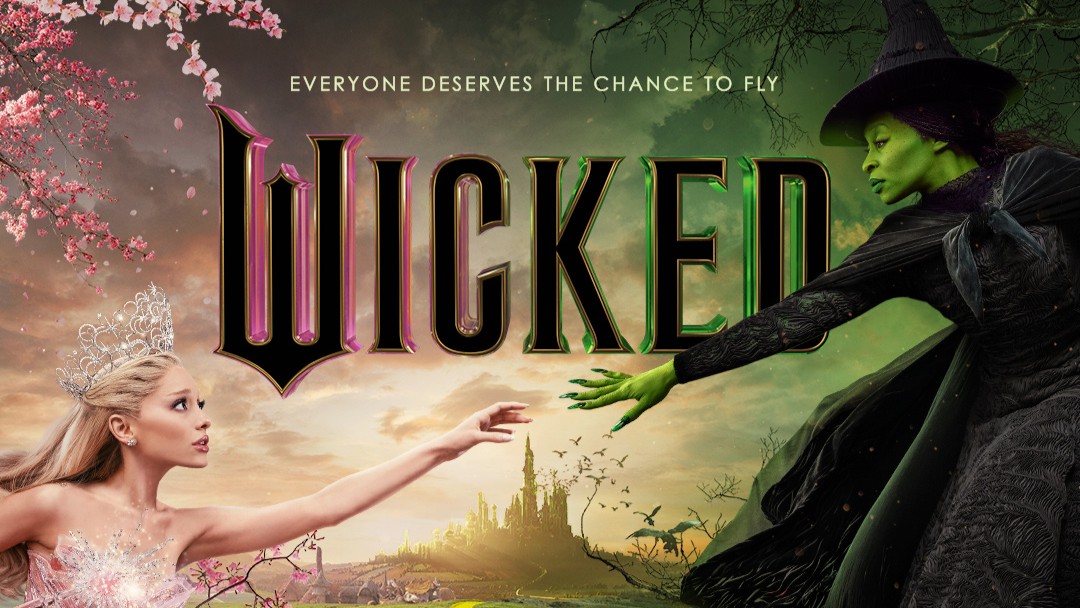
First, though, I want to discuss the choice to cast Cynthia Erivo as Elphaba. There’s a pervasive issue in Hollywood, where people of colour are often cast as aliens or fantasy creatures in science-fiction and fantasy, covering them in prosthetics and makeup so they become green or covered in tentacles. It’s not uncommon for most of the main cast be white, with one alien, robot, or fantasy creature who happens to be played by a person of colour. Suffice it to say, I think this comes from a place of seeing people of colour as inherently “other”, and so they are cast more often as non-human by Hollywood.
I can’t help but feel like the choice to cast Cynthia as Elphaba may be informed by these racist ideologies. In a vacuum, I don’t think casting her as Elphaba would matter, and I think casting a black woman in a starring role is great representation. But we live in a society, a racist society, and her blackness is literally erased by covering her skin in green paint, allowing the movie to amplify her otherness, while also leaning on her racialized physical features to further mark her apart from her white co-star, Ariana. However, her blackness is also metaphorically erased, to be replaced by a condition specific to her, rather than something she shares with others around her—except perhaps the animals.
Which means I must discuss the animals in Wicked: Part I earlier than I wanted to, because my problems with the animals are intricately tied to the film’s other problematic elements. Firstly, I think the movie’s use of animals as a metaphor for systemic oppression to be uninteresting. It could be the hyperrealistic, yet somehow uncanny CGI, or the fact that all the characters except Elphaba involved with the animal oppression subplot seem emotionless and bored with the subject, from the human characters to the animals themselves. This could be intentional, but I don’t believe so, as I think the narrative sequesters the main plot from the animal subplot, placing them in two different genres of movies. It just doesn’t feel like I should care about these animals beyond the basic empathy I would otherwise have for animals, which is ruined by the CGI models and the lack of character development on these creatures.
Secondly, humanity has a long history of comparing racialized people to animals, most prominently when it comes to Black and Asian people. Making the only source of racism and oppression in your world a metaphor involving animals is a bad take, in my opinion, one which could and should have been caught during the film’s development. This may be something that has always been part of Wicked’s story. I don’t know enough about the book or musical to know if that’s the case. Regardless, I think it would have been something worth revisiting. I think even making the animals anthropomorphic may have been enough—it’s difficult to know for sure, as they may have suffered the same fate as Elphaba and be cast entirely by racialized actors. It’s also possible using animatronics or stylized animation would have worked. Again, difficult to know for sure.
I also think attaching such a serious topic to whimsical talking animals feels laughable, losing the gravitas they’re obviously going for. It could be that the film was hoping that same basic empathy for animals would be enough to bridge the gap, and it was also trying to advocate for the fair and ethical treatment of animals. But I don’t think the message comes across at all when placed next to the bombastic whimsy of Elphaba and Galinda.
To be clear, there are other Black people in the movie besides Elaphaba: her sister, her mother, and some other background characters. There are also other people of colour, such as Michelle Yeoh as Madame Morrible and Bowen Yang as Pfannee. As far as I can tell, these people do not experience systemic racism in the film, and so we must conclude that racism doesn’t exist in the world of Oz. Speciesism definitely exists, because of the aforementioned oppression of animals, but racism itself doesn’t seem to exist.
The question of racism—or any kind of bigotry—is a common problem in speculative fiction. There are generally three approaches to how science-fiction and fantasy handle racism, each with their own pros and cons, their adherents and detractors.
The first and most common method of dealing with racism is to use metaphor—often as a way to circumvent censors or bigoted producers—in the hopes the message will come across and the audience will make connections to real world issues. The problem with this approach is that people who have not examined their racist biases, or who actively endorse racist ideals, will be ignorant of the metaphor, or willingly feign ignorance, if it serves their purposes. Metaphor racism also tends to ignore or supplant the real-world struggles of marginalized people, especially for stories set in something close to the modern day. Finally, this portrayal of racism often inadvertently justifies racism within the narrative, leading to a misunderstanding of how racism works in the real world.
I think Wicked: Part I was going for this approach with the animal oppression subplot, but I’d argue they failed in that regard, for the reasons I previously mentioned—namely, the fact that what Elphaba is experiencing is not systemic racism, and the animals are a poor metaphor for oppression.
Instead, what I think ends up happening is the erasure of racism altogether. This is something that science fiction and fantasy often do to present an idealized version of our current society: a world without racism, sexism, or bigotry of any kind, a world in which black people have never faced slavery, where all genders are equal or homosexuality is as normal as breathing. In some cases, it can work, especially if the world is so far future as not to have ties to our current history, or is an alternate universe in which humans just happen to exist—as is the case with Oz, as far as I know.
The problem with this approach is when the fictional world is closely tied to our current reality, such as near future or modern speculative fiction, or the historical setting is somehow tied to our own past. With this approach, the author is trying to have it both ways. They want to include representation, but don’t want to touch on why representation is necessary in the first place, effectively erasing the lived experiences of marginalized people.
The third and most difficult approach is including racism in your story, in a way that acknowledges the real world implications of systemic oppression without metaphor or erasure. I don’t know if this is always the best approach—if we’re speaking solely about crafting an interesting narrative—but it does feel like the most inclusive approach. Then again, it can backfire if the racism veers so far off from social commentary that it becomes fetishization. It can also be difficult to pull off, though I think it’s best to attempt it and take criticism, then to not do it at all.
If we accept that Wicked: Part I ultimately chooses to exclude racism from its narrative, then what Elaphaba is experiencing ends up being morally reprehensible at a personal level, but morally ambiguous when viewed from afar.
Othering someone because of their appearance or capabilities is never justified. However, there is no evidence in the narrative—beyond the treatment of the animals—that someone with green skin would be immediately rejected as other. There may or may not have been green-skinned people before Elaphaba. It’s never addressed in the film. So it doesn’t make sense they would outright reject Elaphaba at birth. In actuality, I would expect the people of Oz to welcome her with curiosity and whimsy, if anything. The fact that she’s so completely ostracized only makes sense if you associate her treatment with that of the animals, which, at best, is a wild connection to make, and at worst makes the narrative morally reprehensible and a racist insult when the movie is critically examined as a piece of art.
Her magical powers are an entirely different manner, as I’d argue that the denizens of Oz have reason to fear her for her magical powers. It’s heavily implied that magic once existed in Oz, but it has all but disappeared for some unknown reason. It’s possible that the slow erasure of magic is tied to the arrogance of humanity, but it’s unclear if that’s the case, and I’m unwilling to meet the movie halfway until it’s made explicit. While performative illusion and misdirection is used by Oscar Diggs’ and Madame Morrible to enamour and terrify Oz, real magic is an oddity, a chaotic force which is unusual and dangerous.
Elaphaba having magical powers, with no way to control that power, in a world which does not have real magic, is genuinely terrifying to think about. Do I think that justifies the complete ostracization she is subjected to? No. But I do think the fear is justified, even if the resulting actions are not. I think this is what makes Elaphaba treatment by society morally ambiguous, though I wonder if it’s worth moralizing the actions of the Oz at all. If I take a second to think about how magic is celebrated in Oz, and yet the only true example of magic is shunned based entirely on the colour of her skin—none of it makes any sense.
I share my opinions on this movie, both good and bad, because I genuinely enjoyed it as a musical. Most of what I discussed in this critical analysis used Wicked: Part I as a jumping off point to discuss topics which are problems across Hollywood, media and storytelling, not just this movie. The fact that I’m writing this at all—after years of not sharing my thoughts about a movie on paper—is evidence that this film sparked something in me and became a core memory of sorts. I can see myself revisiting it again in the future, when the second part comes out, or just whenever the mood strikes.
I say this because, by sharing my unsolicited thoughts on the movie, I am knowingly contributing to the over critique of media aimed at women and the queer community, while seemingly leaving male-centered media unexamined. I’d like to think that, for me, it comes from a place of love and a desire for things to be better, but I know I need to be aware of my own biases. I also want to make it clear that when I criticize media like this, I am directing that criticism at the producers and studio executives in charge, not the writers, directors or audience.
My hope is that by criticizing media that is already trying to be inclusive, diverse and equitable, we’ll get more of the same, with even more diversity and inclusion. As for those action blockbusters which don’t even try to be better, well—let’s just say, I don’t think there’s any hope for them at all.
As for the film’s narrative, the beginning was strong, the middle dragged, and the ending was unsatisfying. The story is stretched thin to cover the film’s over two-hour runtime, satisfying the sense of unease I had felt upon seeing Part I in the movie’s title card after the introductory number, No One Mourns The Wicked. As mentioned, the animal subplot, divorced from its problematic issues, isn’t that interesting and doesn’t make much sense in terms of worldbuilding. The narrative also suffers from the problems which necessarily afflict all musicals, wherein the motivations and inner worlds of the characters are said out loud, even in between numbers.
In short: “It was alright.”
But also: “It was a fantastic musical.”
Select a result to preview