


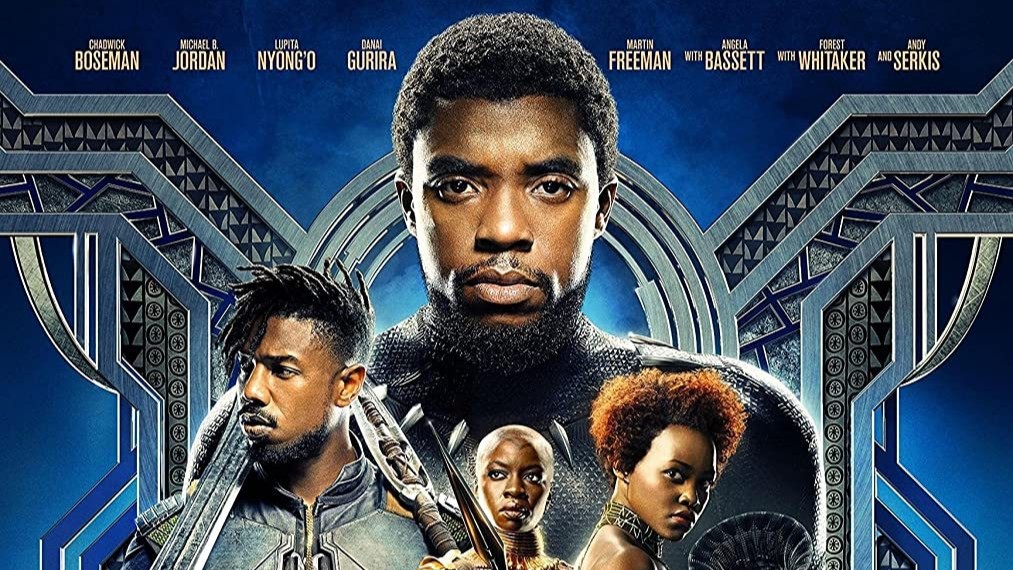
Directed by Ryan Coogler
2018, Marvel Studios
2 hours, 14 minutes
Rating: ★★★★☆
I feel that, in distancing myself from the group who does “not want to criticize [Black Panther] out of fear of being called out as racist”, I attempted to wash my own hands of racism. Racism is primarily a systemic problem, something which we all participate in—myself included. I cannot separate myself from racism any more than I can separate myself from sexism. In retrospect, I should have taken this into consideration while writing this review, instead of trying to appear unbiased.
I also believe I was too quick to proclaim the intended audience for the film. Ryan Coogler was working under heavy scrutiny during the development of the film, and still managed to create something which Black people celebrated, while simultaneously appeasing his corporate masters, who were largely white. I now think Coogler tried to make something for Black people, but Marvel Studios fully intended the film to be marketed to white people. The inclusion of sympathetic white characters is an example of the latter, and the fact that I fell for it is something I should acknowledge.
Of all the geeky films to come out recently, I’ve found Black Panther to be the most polarizing and the most justified within its polarization. There have been some other divisive films—such as the Star Wars films—but it seems as though Black Panther has caused the most lasting impact. On the one hand, we have a group of people who have uplifted Black Panther as a cinematic masterpiece for its excellent representation of African culture. On the other extreme, we have a group of people who feel the film is lacking in some way, but do not want to criticize it out of fear of being called out as racist. I sit in neither of these camps. Truth be told, I had little interest in seeing Black Panther. I don’t think this to be the fault of the film though. I was not the target audience this film. I did end up enjoying Black Panther when I got around to watch it, though I feel as though the movie would have conveyed its themes better if it had introduced Killmonger-as-King earlier in the film.
The strangest aspect of Black Panther for me was that it uses the MCU formula. I had expected Black Panther to stray from the Marvel formula to focus instead on cinematography and narratives normally associated with Black media. However, Ryan Coogler did a good job of fusing African culture, Black culture, and the Marvel identity together into one film. I never felt lost in the narrative from a lack of familiarity with the culture, and I believe this is what lead to the movie’s popularity. There are a lot of problems with presenting a watered-down version of any culture, especially when the audience is predominantly white. It may lead to prejudice, stereotypes, or discrimination if an actual person of colour does not fit previously established expectations. And yet, if the uninitiated are exposed to everything a culture has to offer at once, they inevitably succumb to culture shock and may—in extreme cases—feel repulsed by the culture. Black Panther itself explores cultural exposure within the characters of T’Challa and Killmonger. T’Challa appears either ignorant or apathetic to the lives of others of African descent in the world, while Killmonger has a very narrow view of Wakandan culture that fits his established viewpoints. Both go through many hardships while wrestling with their prejudices, but I ultimately believe the movie’s themes were undermined by its structure.
Black Panther can be broken down into two distinct narratives: Killmonger’s plan to liberate his kin and the search for Wakandan identity by T’Challa. While these two narratives intersect near the midpoint of the film, I believe that focus being split between the two does more harm than good. The search for Wakandan identity is obvious, as characters express their views directly and without nuance. Some moments are incredibly potent, such as the conversation between Nakia and Okoye. However, since we are not given the time or space to consider these various viewpoints, we have to accept T’Challa’s decision at the end of the movie without question. What could have been a deep dive into balancing identity with social duty ends up as a shallow moral lesson without any lasting impact. There are similar problems with the Killmonger narrative. I think his story is very compelling, and is unique from other villains in the MCU. Michael B. Jordan’s performance is amazing. He fully inhabits the character, convincing us that Killmonger went through a lot to be where he is today. With that in mind, I believe that one simple change in the plot would help to resolve issues with both parts of the film.
T’Challa should be challenged and defeated by Killmonger at his coronation, and not midway through the film. Black Panther spends a lot of time at the beginning of the film establishing T’Challa as a good but conflicted man while providing exposition for Wakanda—I don’t believe this time is well spent, as it makes the climax of the film feel rushed and a little nonsensical. Also, M’Baku’s appearance at the coronation doesn’t have any impact for me. I felt nothing for M’Baku and his tribe, and it wasn’t until his rescue of T’Challa that he felt like a fully fleshed out character. Moving T’Challa’s defeat to an earlier point in the film gives Killmonger more time to win over the people of Wakanda. While it may make sense within the context of the world, it doesn’t make sense that a reclusive, peaceful people would suddenly be okay with becoming warmongers overnight. Killmonger has a lot of personality, but he still felt one-dimensional and flat. Perhaps it is my backwards viewing of Infinity War, but I feel as though Thanos was more human than Killmonger. Killmonger feels more like a teenager’s idea of a badass: smart, violent, cool, and collected, gives no shits and always wins—even when he loses. Perhaps that was the point. I can’t say for sure. But I truly think that the film would have been better if we had more time with Killmonger-as-King. It would have also given us more time to explore Wakandan identity and T’Challa’s inner conflict while he attempts to win back his throne. Heck, we could have even spent less time with Klaue. While a fun character, I don’t think he brings anything of substance to the film.
The only reason I can think that so much time was spent on establishing the setting and the characters is because Black Panther was meant to appeal to people outside the MCU. Many people would be coming in to see Black Panther with no prior knowledge of the MCU. The film has to show that Black Panther is not just a token comic book film, but a real attempt to represent people of colour. However, I like to think audiences can appreciate the film without needing a primer in Marvel lore first.
Notwithstanding, Black Panther is a great film. The sound design in particular is amazing. From sound effects to the music choices, to the primal sounds of chanting and hooting, the movie has lovely sound production throughout. I was constantly impressed by the visual design as well. Costumes, makeup, sets, and the sand-based holograms are some of my favourites. I was not a fan of the hover planes and other technologies. They felt out of place to the bright and colourful designs of Wakanda. One aspect of the film that surprised me was the humour and the emotional impact of the characters. I found myself fond of T’Challa and Shuri brother-sister relationship. Their interactions were constantly genuine and funny—give or take one or two “What are those?!” references. I was also invested in Okoye’s character growth, though I was disappointed the conflict with her husband was not explored further. Perhaps if we had more time with Killmonger-as-King, this could have been expanded on as well. On a personal note, I was happy to see Martin Freeman in this, even if his role was rather drab. I’ve been growing fond of him since his part as Watson on BBC’s Sherlock.
Black Panther is a film more important than my opinion of it. Its representation for people of colour remains as its most important element, and contributes most to the film’s impact. No criticisms of the film can ever take away what that means for people of colour. It is also a genuinely good movie with a stellar cast of characters, great music, and interesting visual design. The narrative fails to convincingly convey the movie’s themes, but that shouldn’t take away from what an achievement Black Panther has been. If we see another Black Panther, I hope we can focus more on exploring themes relevant to people of colour, and less time on exposition. It can be scary at first—some audiences may even be turned off by a lack of exposition. But we need not look further than the MCU for a narrative that works without exposition. Spider-Man: Homecoming showed that you can have a fun superhero film without spending too much time on establishing setting and characters. All you need is a vibrant world, memorable characters, and compelling themes.
Select a result to preview