


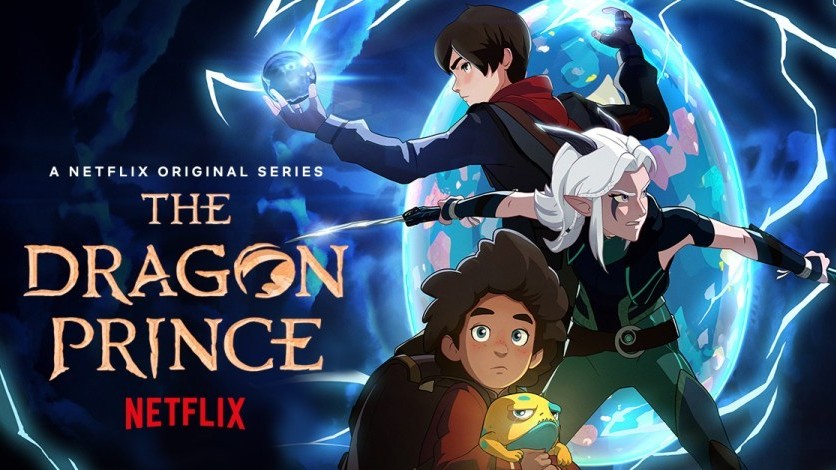
Created by Aaron Ehasz, Justin Richmond
2019, Netflix
9 episodes, 25-27 minutes
Rating: ★★★☆☆
I went into The Dragon Prince with low expectations. I had heard that some of the creative minds behind Avatar: The Last Airbender were the showrunners, but something about the look and feel of the show put me off. My fears were realized when I loaded up the first episode and got turned me off immediately by the terrible opening prologue. I also thought I could forgive the animation style if I gave it a chance, but I just couldn’t get past it. So I set The Dragon Prince aside and didn’t come back to it for a few weeks. Unfortunately, my opinion of the animation style didn’t improve, and the prologue became indicative what the quality of the writing would be for the majority of the season. These issues made my overall experience of The Dragon Prince a negative one, but I did end up being fond of the characters, even though the world and plot were ultimately uninspiring.
The characters of The Dragon Prince surprised me on multiple levels, beginning with how gradual their personality emerged. I was also surprised by how well developed a lot of them were. The difference in quality between character and plot writing is staggering. It never felt like the characters were ever part of the world—or had any real stakes in the story—despite standing as examples of great character writing. Everyone feels fleshed out and real, with a few exceptions. I think it’s worth breaking down the characters and my opinion on each.
While annoying at times, Callum is simultaneously an awkward teenager and a great older brother, balancing the two roles perfectly. He is confident but at the same time not, leading to some interesting conflicts. I was a bit put off by his voice (I could sometimes hear Sokka in him), but I don’t think that should be taken into consideration when evaluating him as a character. The only issue I had with Callum was how the writers seemed to pick him most often for their plot contrivances, wherein he does things out of character to move the plot along—like having a “we need to argue so we can learn something” argument with his brother. Even if almost all the characters suffer similarly throughout the season, it seems to happen more frequently with him.
Of all the protagonists, Rayla feels the most developed. She has a particular way of life and grew up believing a specific ideal, but has not yet decided who she is. Her actions mirror this at every turn, as she struggles with her own values and the duties put on her by her people. She responds to a lot of her problems with sarcastic remarks in an attempt to hide her insecurities about her own capabilities. It was her introduction and subsequent development that had me hooked. I doubt I would have continued watching if not for my investment in her character arc.
When talking about the quality of the character writing in The Dragon Prince, I mentioned a few exceptions, and Ezran is one such exception. Perhaps his lack of complexity could be explained away since he’s a child, but considering the work put into the other characters—and the fact that he and his pet Bait are the source for too many plot contrivances—I don’t believe that’s the case. Still, his character is solid, but I found myself disliking any scene where he had a prominent role.
Of all the characters, Claudia is the one that surprised me the most. What started as a “crush” love interest for Callum, turned into a multi-faceted character. She’s characterized as quirky, but she displays much more complexity as time goes on, being intelligent, inventive, and decisive. It’s one of the few times I enjoyed a character that fills this trope. I particularly enjoyed the playful banter between her and her brother Soren. She’s also never used in any of the plot contrivances that I remember, which made her one of my favourite characters.
Soren is the bully character done right. In a modern setting, he’d be the high school jock with a football jacket, giving nerds wedgies, and hitting on girls. But like most of the characters in The Dragon Prince, his character writing is superb. He’s kind of a jerk, but he has heart and does what he thinks is best, even if he’s not always sure what to do. He’s not one of my favourites, but I enjoyed his interactions with other characters, be it Callum, his sister, or his father.
It can be difficult to create a sympathetic villain, especially when writing stories for children. It’s often easier to make the villain evil instead of just villainous—capable of heinous acts that no sane person would do, but ultimately unrelatable. Viren engages in all the activities we would expect from a villainous, treacherous royal advisor. However, all his actions are believable, making sense within the political climate of Katolis. He’s conniving and scheming, but it never feels as though he does anything with ill intent or for the sake of evil. He’s just doing what he thinks is best, regardless of the cost to himself or the ones around him. That makes him a much more compelling villain in the long run—one that blurs the lines of morality while making it clear that what he does is wrong.
I’m sad that we don’t get to see much of King Harrow, since he quickly became one of my favourite characters. He is level-headed and principled, but swept up in his duties. For a fantasy setting, he’s quite relatable. Even his attitude towards Viren can be seen as rational. Viren appears to be deluded as to the nature of their relationship, and Harrow wants to draw clear boundaries in response to Viren’s behaviour. I also enjoyed his relationship with Callum, though I’m a bit disappointed we didn’t get to see him interact with Ezran (which may contribute to my dislike of him). I’m not totally convinced we’ve seen the last of Harrow. Maybe that’s just wishful thinking on my part, as I felt the quality of the narrative quickly dropped after his assassination.
Amaya was at the centre of many of the discussions about the show at release, due to the fact that she is deaf. She uses ASL and has an interpreter, showing the commitment the showrunners had in properly representing those with hearing impairments. She also has—hands down—the best character design, which surely contributed to her initial popularity. I was consistently surprised with how intelligently she was written, from her earnest demeanour, to her absolute conviction in doing what’s morally right. She became my favourite character as soon as she was introduced, helped by the amazing fight scene between her and Rayla shortly thereafter, which had me exclaiming audibly in astonishment at how well the fight was choreographed.
I don’t really have an opinion of the rest of the cast. I liked Gren, but he turned into comedic relief once separated from Amaya. The rest of the cast were either bland, annoying or used purely for plot purposes and, as such, were underutilized.
All the characters had consistently great character designs. I’ve mentioned some of my favourites already—namely Amaya and Rayla—but I have no issues with the design of any of the characters. I also appreciated the amount of diversity among the characters. Of course, the humans in The Dragon Prince don’t share our history or cultures, but it’s nice to see different skin colours, even if they’re not attached to specific ethnicities. I also really enjoyed the design of the moonshadow elves, even though they’re basically just Night Elves from World of Warcraft. Their voices in particular were a welcome change from the normally pompous or breathy way elves tend to speak in fantasy settings. Overall, the voice actors delivered a great performance, being able to convey emotions and concealed intentions through speech, which—along with great character writing and designs—made the characters of The Dragon Prince complex, interesting and deserving of a more well-written narrative. I have to mention, though, that creature designs were subpar by comparison, childish in their design or unappealing to look at.
I’ve come to the conclusion that the writers and maybe the showrunners behind The Dragon Prince created and then developed the characters and premise long before ever writing a narrative for them. The signs are all there: the characters are incredibly well-developed, but don’t really feel like they belong in the world. The story is strong at the beginning of the season, but then meanders and feels disjointed right up until the end. There are some great moments here and there: Amaya’s fight with Rayla, the elven dagger, interactions between Viren and King Harrow—these moments teased at what could have been, but I’m convinced that the writers had little to go on beyond extensive character profiles and an intricate political struggle. Any time the story focuses on anything substantial, it falters. The stakes never feel like they matter, and the tone shifts from dark to light-hearted from one scene to the next. A character might be afraid to lose their arm, and within seconds be comically afraid of the water. There’s no consistency in the tone, so it’s difficult to care about what happens to the characters, regardless of how appealing they are.
The tipping point for me was when Ezran fell into sub-zero water for way longer than a child should, and yet he came out feeling only slightly uncomfortable instead of dying from exposure. I’m not one to judge realism in fiction, but when their father was just murdered and there’s a chance that Rayla might lose a hand, I just couldn’t buy into the story any more. Things just got even more nonsensical from there. Thankfully, I had already checked out of the story at this point, so I didn’t have to suspend my disbelief any longer. It was clear to me that the narrative was just a means to an end—a way for the writers to get from point A to point B:
Everything else is just moments in time, sequences without any reason to be there except padding, strung together loosely to form a weak narrative. It’s a shame because the script is at times brilliant, normally when characters interact in meaningful ways. I’ll always remember when Amaya goes to visit her sister’s grave and Viren comes to reconcile with her, as well as the conversations between Callum and his step-father. There’s just nothing to support these moments, nothing to invest myself in beyond the quality of the characters themselves. As such, I have little interest in seeing where the story goes next, nor do I think it’s worth recommending the series.
Finally, I don’t know if I’m just getting out of touch with animation, but I personally don’t understand the use of reduced frame-rates in 3D animation. I can’t decide if it’s a budgetary decision or a stylistic one, but I don’t like it either way. It reminds me of stop-motion animation, but without the inherent charm that kind of animation possesses. Or maybe it’s the lack of exaggeration as I don’t remember a single instance where animation principles like squash and stretch were applied to exaggerate actions or emotions. The animators seemed more concerned with keeping the characters on model rather than in creating a visually engrossing work of animation. I think part of the reason I judge the animation so severely is that I attribute this style of animation with amateur video game machinima, especially films made in applications like Garry’s Mod. It feels unprofessional and underdeveloped. It doesn’t help that everything except the character designs is bland and uninteresting. Characters stood out like actors on a poorly designed community stage, never really feeling a part of the world they inhabit. The only exception might be the magic effects, which were creative and fun to look at. Of course, my opinion on the visuals is highly subjective, so I can’t fault the show for it.
However, I have no issue with criticizing its writing. I hope that the next season fares better in that department than the first. With its well-developed characters, The Dragon Prince has the chance to break through popular culture to reach the same heights as Avatar: The Last Airbender, maybe even defining an entirely new generation of children. But they can’t expect their characters to bear the full weight of that burden. These characters deserve an engrossing narrative, one which allows them to shine and interact in meaningful ways, to shape the world and to be shaped by the world around them. The Dragon Prince has a great foundation, but it has failed so far build on it. If the writers can expand on the political struggles that impressed so many within the first half of the season, I can only imagine what kind of show The Dragon Prince might become.
Select a result to preview