


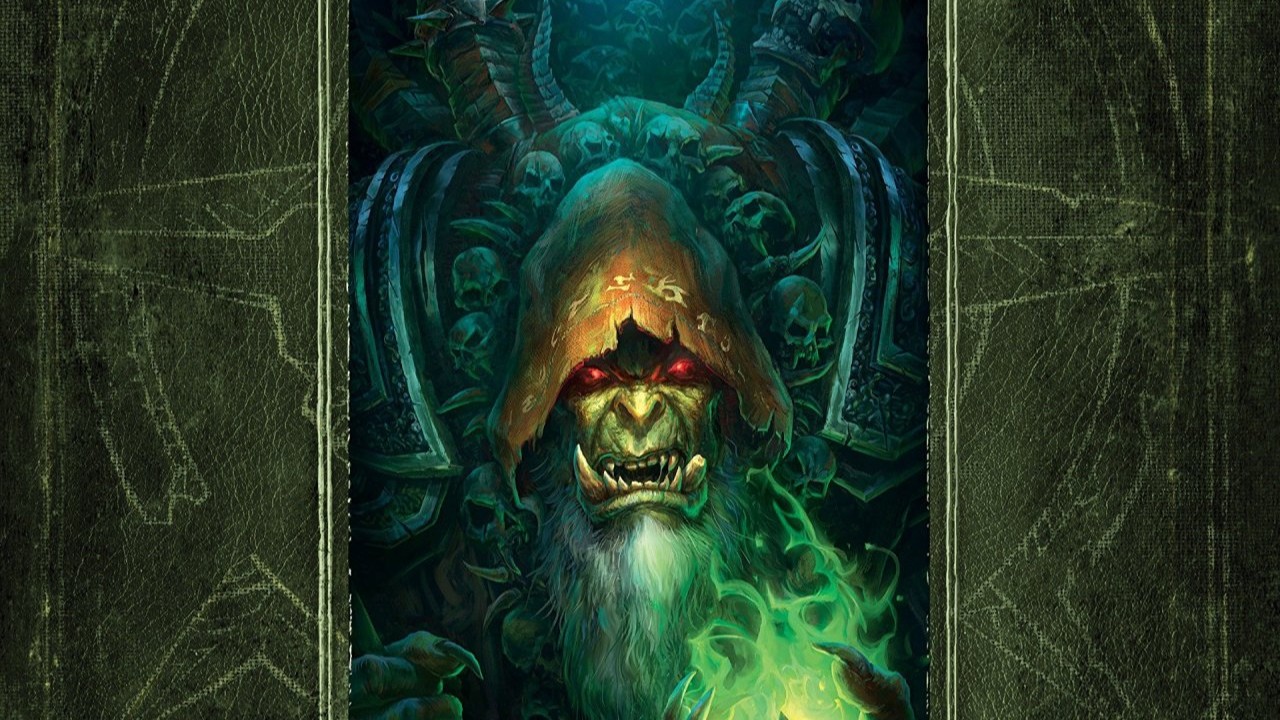
by Chris Metzen, Matt Burns, Robert Brooks, Peter Lee, Joseph Lacroix, Alex Horley
2017, Dark Horse Books
Hardcover, 208 pages, $39.99 USD
Rating: ★★★★★
Many of the criticisms I have for World of Warcraft: Chronicle Volume 2 are similar to the ones I had for Volume 1. To summarize:
And yet, I believe that the second volume does not suffer as much as the first volume, as the second volume focuses on Draenor and most of the material is pulled directly from tie-in novels or the first Warcraft game. I also enjoyed this volume a lot more than the first one. As before, I have not read the third volume as of writing this review. I think the second volume does a good job of providing historical context for Draenor in a fresh, cohesive manner while faithfully retelling the events of the First War, Second War, and the expedition to Draenor. Most of my issues this volume are personal and shouldn’t be taken into account when judging the quality of the text. The only major fallback in this volume is the increasing use of callbacks, which was as jarring as the use of “no one knows” in the first volume.
While I noticed the use of callbacks in the first volume, they became much more common within the second volume. I define callbacks as points in the narrative where the writers refer to an event previously left unexplained, and then proceed to provide details on said event in a separate narrative block. This wouldn’t be an issue if the purpose of the Chronicle was to tell the history of Warcraft. But as I concluded in my review of the first volume, the Chronicle is a storybook, not a textbook. The use of callbacks is a halfway measure—an attempt to tell a story while keeping the textbook format. And since most of the material in the second volume is pulled straight from tie-in novels, it’s obvious that these stories are meant to be enjoyed as literature and not as reference text. I must again conclude that the writers are sometimes just lazy, as they could not be bothered to properly segway moments in the narrative, using callbacks to detail important events instead of doing so when the event is first mentioned. They are more concerned with isolating story beats from each other than providing a cohesive narrative. Thankfully—as far as I could tell—they did not repeat their use of “no one knows”, as I can’t remember a single instance of it in this volume.
I was surprised by my enjoyment of Draenor history featured in the first half of the second volume. There were some changes I was uncomfortable with, but the story was well told and made sense within the context of the world. Maps are still lacking, though I don’t believe they were as integral in this volume as they were in the first. Draenor isn’t as important as Azeroth, so I was okay with there being only a minimal amounts of maps. I also enjoyed revisiting the events of the First War, Second War, and expedition into Draenor. The original tie-in novels had been entertaining, though the details of each event in Azeroth’s history were always a bit vague to me. The Chronicle helped to solidify my understanding of those events. In particular, I was happy to have the events leading up to the opening of the Dark Portal retold in a more straightforward manner. Jeff Grubb did a magnificent job in Warcraft: The Last Guardian in telling a compelling story, but the actual events and their impact were always a bit hazy to me. The writing in Chronicle continues to be suburb, and I read the entire volume in one sitting, despite its length.
World of Warcraft: Chronicle Volume 2 is much more promising than the first volume, though that could be due to how solid Draenor lore, the First War and the Second War are within the Warcraft mythos. After all, the First War harkens back to the events in Warcraft: Orcs & Humans, a game from 1994. Blizzard has had years to refine and re-imagine the events from that era. And the recent Warlords of Draenor expansion allowed Blizzard the freedom to build a new world from the ground up, without being constrained by previous entries in the series. World of Warcraft: Chronicle Volume 2 really shows what hard work and excellent worldbuilding can do for a franchise.
Just as with the first volume, I want to preface the following as being my personal observations regarding changes in the lore. My opinions should not be used as a critique of the quality of the Chronicle. There are also some minor spoilers from the Chronicle itself and from secondary media.
Once again I am torn on the use of Titans within the lore. As previously mentioned, I was surprised by how much I enjoyed Draenor’s history. I had not had the chance to read into the lore when I played through Warlords of Draenor, primarily because I had little interest in the concept of time-travel or alternate dimensions. But the history of Draenor is fascinating and rich, with civilizations rising and falling, whole ecosystems uprooted, and destroyed over millennia. It’s unfortunate—if not a little ironic—that Aggramar was the one to ultimately seed the orcs. I’m not a fan of having all important elements in a narrative originating from the same source. Life is random, and fiction should try to emulate that. Not everything needs a reason to exist or some grandiose origin to be important.
While I enjoyed the changes to primeval Draenor, some of the changes made to orc history hit me hard, particularly when it came to Gul’dan. I thought Golden’s telling of the rise of the Horde was one of the best pieces of storytelling in Warcraft lore, so I was a bit miffed when some of her work was replaced by new lore included in Warlords of Draenor. I can only attribute it to the sudden infatuation Blizzard has had with Gul’dan since Warlords of Draenor, continuing all the way through Legion. I’m personally not a fan of Gul’dan. He always seemed comically evil, even when compared to other villains like Arthas and Deathwing. I’m also having a hard time coming to grips with the changes to Void lore that began in the first volume. With the Hammer of Twilight and Cho’Gall making their appearance, I pine for the days where these characters could just be crazy without needing an evil force whispering doomsday in their ears. Oh, and the fact the ogres had a thriving civilization is still difficult for me to swallow, especially considering the way the orcs interacted with them a hundred or so years before the opening of the Dark Portal.
I had no issues with anything following the opening of the Dark Portal beyond the need to repeatedly mention how characters were only pretending to trust each other. I would have also preferred that Sargeras have nothing to do with the orcs until after they were corrupted by Mannoroth and Kil’jaeden. I’d like to think Kil’jaeden would go out of his way to hunt down the Draenei, only to fail. In the wake of his failure, Sargeras could then swoop in and use the orcs as a way to weaken the mortals on Azeroth. In general, I have issues with how the Burning Legion’s power is represented. They have the ability to open a portal to Draenor without a warlock’s aid to materialize a pit lord, but they cannot summon Archimonde, Kil’jaeden, or Sargeras to Azeroth without aid of mortal? It could be easily explained away as Azeroth being protected by the Titans or the Old Gods, but so far it just seems as though their power is as strong as it needs to be to move the plot along. I’m also interested to see how Blizzard will eventually handle the fact that there’s an entirely separate reality with another Burning Legion, but that will have to wait until the fourth, currently unreleased volume.
Select a result to preview