


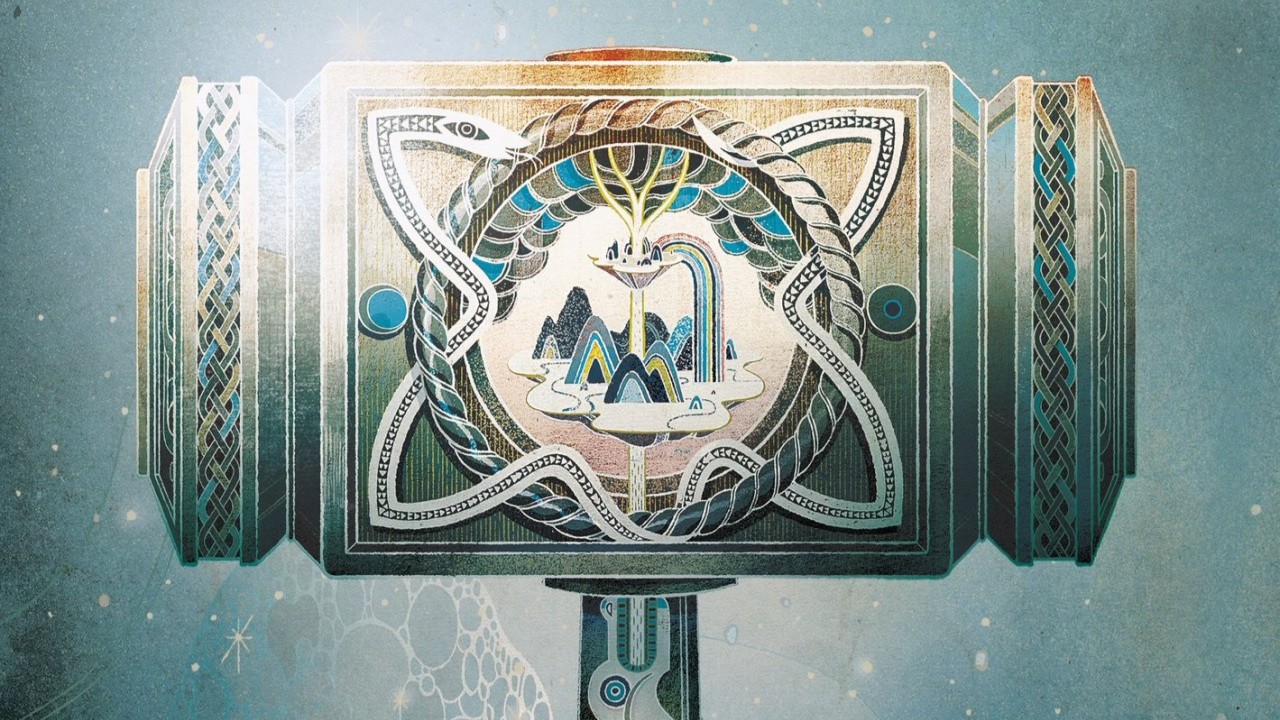
by Neil Gaiman
2018, W. W. Norton & Company
Paperback, 300 pages, $21.95 CAD
Rating: ★★★★★
I wrote this review prior to Neil Gaiman’s sexual assault allegations. I no longer support his works. That being said, I believe my criticism of Gaiman’s changes to the source material which resulted in additional female representation comes off as misogynistic. Norse mythology is poorly recorded, and so any interpretation would be biased in some way. That Gaiman included additional female representation in his interpretation should be commended. I still hold that I dislike forewords.
I’d also like to clarify that I have not yet proven that I have Scandinavian heritage, and so any claims to such heritage on my part are speculative in nature.
I don’t know what first triggered my interest in Norse mythology, but I do know that Norse lore has been creeping on the edges of my consciousness for as long as I can remember. I vaguely remember Marvel’s Thor from when I was a child and some passing references to Norse gods in popular media, but I’d have to point to World of Warcraft as my first real plunge into Norse folklore. World of Warcraft’s Wrath of the Lich King expansion took heavy inspiration from Norse mythology and Viking culture when conceptualizing the Vrykul race, complete with horned helmets, naval raids, and braided, waist-length beards. Everything from the visuals to the music awoke in me an appreciation for a rustic Scandinavian aesthetic, fuelled by a prior knowledge of my Scandinavian ancestry (my father’s ancestors immigrated to Canada from Norway). I’ve dabbled in Norse-inspired art, games, and art since then, but I’ve never really fully engrossed myself in the lore. It was by chance that I came upon Norse Mythology by Neil Gaiman at my local bookstore. I was intrigued, so I decided to give it a try. I had just recently read American Gods on one of its re-releases last year and on reading a snippet of Norse Mythology, I instantly recognized that Gaiman’s writing style would lend itself well to the subject matter. In Norse Mythology, Neil Gaiman does a good job of retelling Norse folklore as he has come to know it. He weaves an entirely new take on beloved stories of old, putting together the broken pieces as he goes. It can be difficult to take an existing story and update it for a newer audience—as I myself have done before—so I was happy to see justice done to these old Norse stories. The only criticism I have for the book is for its foreword, which negatively coloured my experience of the book.
I don’t normally enjoy reading the foreword. A part of me wants to say a foreword indicates a defect. Either the editor or author feels the need to explain something they couldn’t through the narrative, or they want to boast previous successes. Or perhaps they feel the need tell the reader how they should enjoy the work presented to them. But after some reflection, I have to admit that I just find forewords unnecessary. Editors and authors use them to advertise a book you already have or to thank people you don’t even know. Forewords may even detail sources and authorities that aim to validate the information in the book. None of this really impacts me. If I decide to pick a book and I enjoy it, it’s because it’s a good book. I don’t need the author or editor to convince me one way or the other. While the foreword is normally a bore for me, it can also tarnish the experience of the entire book. Sadly, this was the case with Norse Mythology. I didn’t want to know that Gaiman cobbled the book together through broken records, updating the narrative to his liking as he went. It coloured my experience so that certain moments felt artificial, despite his best intentions. Any scene with the female gods is a good example. I enjoy that he gave them a more active role in the story, but since he had mentioned his intention to include more diversity, scenes involving female characters felt fabricated for the sake of inclusion. This may sound strange for a book about mythology, but the foreword’s effect was so strong that it shaped my opinion in this way. As Gaiman himself mentions, it’s likely female characters at one time had a more active role, but my immersion within the story was still shaped by his comments. I don’t mind knowing these things now. If he had included this information following the collection of stories, I would have been able to reflect on what I read with new eyes, giving me an excuse to go back and re-read some sections. It may be easy to say: well, don’t read the foreword. However, when I purchase a book, I like to read it in the order the author or editor intended. In this case, I think it was a mistake to include a foreword, and that a postface would have been more appropriate.
The stories themselves felt familiar yet fresh. Neil Gaiman—as mentioned previously—has a way with words that lends itself well to the grandiose god-speak that has become synonymous with Norse mythology for some time now. Characters, situations, and even magic feels real. In particular, I enjoyed interactions between Thor and Loki. It’s evident that Gaiman has a fondness for these characters and their interactions. There’s some hand waving at places, especially when it comes to believability of locations, but that’s to be expected with these kinds of stories. It was especially interesting for me to relive some of the stories, such as Thor’s wedding or the creation of the realms. I vaguely remember reading these stories somewhere before, and Norse Mythology allowed me to experience them as a cohesive narrative. Gaiman does a fantastic job of placing the stories in order, tying them together to form a narrative that begins with the birth of the Æsir up until their death. He also cuts out what I would consider some of the fat, remnants of oral traditions meant to be told and re-told rather than written down. The book also acts as a resource for those like me who would utilize Norse mythology as inspiration for worldbuilding. While the lore is not significantly complex, the way the gods and their actions interact with the people who spoke of them is what makes it so interesting.
I am not sure if I will be specifically looking for other Neil Gaiman books in the future. While I enjoy his writing, I think he has a very specific niche for his writing style that I don’t have a specific interest in. But he is most likely the best person to have updated these old stories for the modern age. Despite my issues with the foreword, I highly recommend Norse Mythology to anyone interested in worldbuilding or Norse lore.
Select a result to preview