


Developed by ND Stevenson
2018, Netflix
13 episodes, 24 minutes
Rating: ★★★★★
I grew up right outside the window where toyline-centric television shows were at their peak in popularity. Being a 90s baby and living in a French Canadian community made it so I didn’t get exposed to He-Man and the Masters of the Universe, ThunderCats, G.I. Joe, and other 80s cartoons. The only shows I was ever really able to get into were shows like Teenage Mutant Ninja Turtles, or whatever aired before 6 am on YTV, like Voltron or Megaman. My first real exposure to 80s cartoons was through Robot Chicken, which parodied these kinds of shows a lot. All this to say I had little interest in this era of animation. I hesitated to watch She-Ra and the Princesses of Power for this reason. I was afraid that She-Ra and the Princesses of Power would require some investment in the She-Ra/He-Man mythos, or the show would be targeted exclusively at young girls. It was the blogs I follow on Tumblr that eventually convinced me to watch the show on Netflix. The response the show generated was positive, praising its diversity and interesting characters. And while She-Ra and the Princesses of Power is definitely targeted towards young girls (of which I am not), I very much enjoyed it. ND Stevenson manages to present a compelling story, with complex and diverse characters who never feel patronizing or shallow—as characters in children’s shows tend to be. The worldbuilding is also well-done, and requires no prior knowledge of the She-Ra/He-Man mythos from the 80s. My only issues with She-Ra and the Princesses of Power is its resemblance to other shows and a lacklustre ending, but these are small prices to pay for its brilliant execution.
I realized around midway through the series how closely She-Ra and the Princesses of Power resembles Avatar: The Last Airbender, with some passing resemblance to other cartoons like Steven Universe or Adventure Time. Everything from the humour to the major plot points felt familiar and already done. Though, I have a hard time really criticizing She-Ra and the Princesses of Power for its lack of originality as it can be difficult to create something new that’s appealing to everyone. Except, the show doesn’t really have its own identity. It has some great execution and a unique approach to character relationships, but I feel like the writers could have spent more time fleshing out the world and making it stand apart from its contemporaries.
This lack of originality also contributes to my only other criticism with the series: its dull ending. There’s a lot of build up to the final showdown between the kingdoms of Etheria and the evil Horde. I was genuinely invested in the outcome and anticipated that we wouldn’t get a happy ending, based on the way things were progressing. I was then disappointed in how the conflict was ultimately resolved. It felt sloppy and rushed when compared to character development. I wasn’t upset in the way things ended. I enjoyed seeing all the princesses participating and winning the day through friendship—I had no issue with that. It’s just that it felt more akin to the ending of a Saturday morning cartoon one-shot episode than an epic thirteen episode arc. It’s a shame because there’s so much work put into the characters. That the same couldn’t be true for the main story plot is disappointing. I don’t know if this was due to bad writing, bad planning or intentional constraints by the creators to focus characters, but I hope we see better plot writing in the next season.
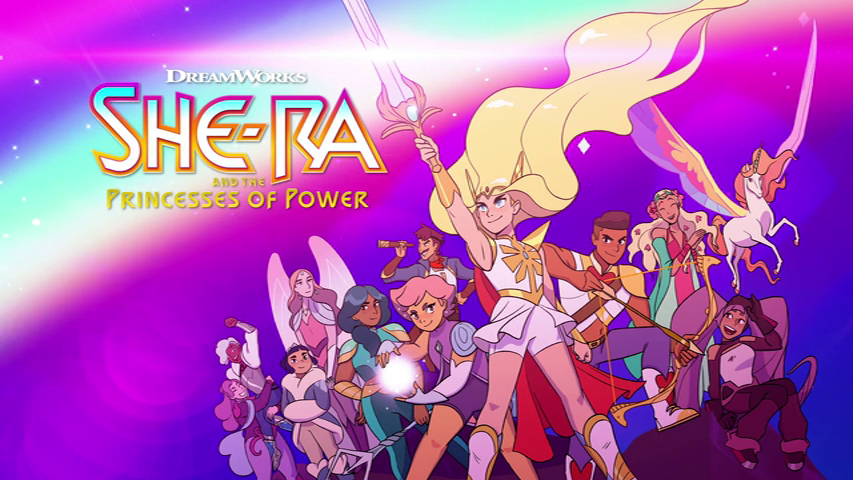
One thing that becomes clear as the series progresses is how devoted the writers are to having a diverse cast of characters. Nearly the entire cast is made up of girls or women, with the only male characters being Hordak, Sea Hawk, and Bow—with Bow being distinctly feminine in appearance and mannerism. Characters are also diverse in body type and skin colour: Bow has dark skin, Glimmer is a bit chubby, and Adora/She-Ra is noticeably tall and fit. I am always onboard for more diversity, especially in children cartoons, where it is important that children can see themselves represented in media. What’s more, none of the characters actively point out these differences beyond some comments on how tall or strong She-Ra is. There’s a clear sense of normalcy to this diversity. Of course, it’s important to directly address issues of sexism, racism, and other types of discrimination directly, but it’s nice to have a show that presents these differences as normal. I also tend to find shows with diverse characters much more interesting and memorable than ones that have three or four of the same milk toast characters with different names, but no real difference between them.
She-Ra and the Princesses of Power also doesn’t shy away from homosexual relationships, having one explicit relationship between the princesses Spinnerella and Netossa, and an implied relationship between Catra and Adora, with Scorpia also being enamoured with Catra. It could be argued that Glimmer and Bow are also part of the show’s queer representation, but I don’t think the writers intended it as such. Just because Bow has some feminine qualities and doesn’t have a romantic interest doesn’t mean he is gay, nor is there any indication that Glimmer, Adora, and Bow aren’t more than good friends. It would be nice to have some homosexual male representation, but as She-Ra and the Princesses of Power is a show targeted at young girls, I can see why it wouldn’t be a priority. Catra and Adora’s implied relationship was one of my favourite parts of the show. In what is essentially an angsty teen romance, the two go back and forth as Adora struggles to reconcile her past while Catra feels betrayed and abandoned. The execution of their interpersonal conflicts is really well done, and is the highlight of the series so far.
Most of the relationships are of this same quality. It very rarely feels like characters are acting just to push the plot forward, and interact with each other in a very human way. Drama is handled well, and nothing is ever pushed to the extreme. One of my biggest gripes with teen dramas is how relationships in those stories are handled, with everyone overreacting and refusing to discuss things openly with each other. By contrast, characters in She-Ra and the Princesses of Power are mostly honest, sincere and actually talk to resolve conflicts. And when they’re not being emotionally mature like this, we immediately feel the impact of their actions. People get hurt or feel their trust is betrayed, but it’s always realistic. Glimmer is a brat, but considering how strict her mom is, her anxieties feel reasonable. Catra’s temper is a logical consequence of her upbringing, so her lashing out against Adora makes sense, especially when we see the internal conflicts she is dealing with. She-Ra and the Princesses of Power trusts its audience to take enjoyment out of a well-crafted story, rather than creating drama for the sake of drama. I find that overdramatic social situations in fiction lead to people to exaggerate their own lives in turn, embodying the mantra: “Art imitates life, life imitates art”. People want to emulate their interests, even as we become more and more obsessed with crafting an exciting life for ourselves, regardless of the negative impact it has on us and the ones around us. Shows like She-Ra and the Princesses of Power demonstrate that you can have an interesting, exciting life while maintaining healthy relationships with others. Relationships in fiction should help us understand the way we approach our own relationships through realistic representation. Fiction shouldn’t be glorifying drama and romanticizing broken relationships.
She-Ra and the Princesses of Power is the kind of show we need more and more in the modern age. It has its issues—like most things do—but just as with Adventure Time and Avatar: The Legend of Korra, She-Ra and the Princesses of Power demonstrates that we have a deep appetite for diversity and sincere character development. One thing that people often forget is that popular media has only really been around for a century, but discrimination stretches much further back. Shows like She-Ra and the Princesses of Power help to chip away at the status quo, bit by bit revealing a much more interesting, diverse and accepting world, where everyone has a place regardless of who they are. As more and more of these kinds of media are featured to large audiences, diversity will become commonplace, allowing for more interesting media to be created in turn. And if even half of them are of the same quality as She-Ra and the Princesses of Power, we’re in for a wild ride.
Select a result to preview