


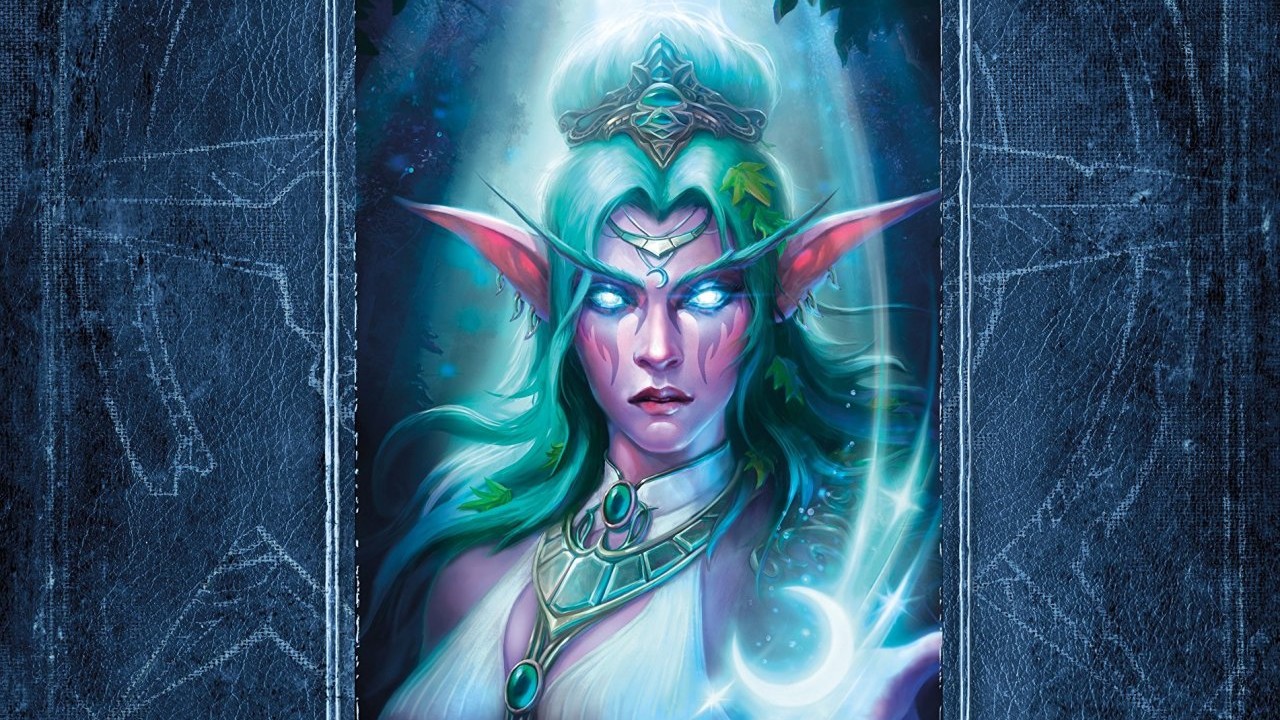
by Chris Metzen, Matt Burns, Robert Brooks, Arthur Bozonnet, Cole Eastburn, Stanton Feng, Roman Kenney, Peter C. Lee, Daryl Mandryk, Yweon Park, Dan Scott, Robert Sevilla, Abe Taraky, Konstantin Turovec, Bayard Wu, Joseph Lacroix
2018, Dark Horse Books
Hardcover, 223 pages, $39.99 USD
Rating: ★★★☆☆
Of the three volumes I have read of the Chronicle so far, the third instalment was the least exciting to me. I think my apathy with this volume is born out of familiarity. Of all the Warcraft lore, I am most familiar with the events of the Third War leading to the events detailed in World of Warcraft. World of Warcraft: Chronicle Volume 3 picks up at the end of the Second War and ends with the destruction of Deathwing at the end of the Cataclysm expansion. I continued to find enjoyment from this volume despite my apathy towards its content, though many of the issues I had with previous volumes have returned, namely issues with maps and formatting. You can read my reviews of the last two volumes here:
Maps were utilized a tad more effectively in this volume when compared to first volume. It’s easier to compare the use of maps in this volume than to the second, as the third volume is almost exclusively set in modern Azeroth. There are even some attempts at showing character movement across the maps, as the movements of armies are sketched out near the end of the Third War. Issues that plagued the first volume are still present: there are not enough maps, and the ones that are there lack legends and the details to provide context. While the addition of infographics was a nice touch, there needs to be more. And yet, map making improvements have given me hope that we will see more detailed and informative maps in future volumes.
Formatting is quite possibly the worst aspect of this volume. The first half of the book—which deals with the events of the Third War—is generally well-structured and follows the same formula we’ve grown accustomed to. Each event is told in its own narrative chunk and then strung together to create an overarching narrative. In addition, the events of Warcraft III and Warcraft III: The Frozen Throne are quite possibly the most memorable events in Warcraft lore for veterans of the series and was the point of entry for many Warcraft fans—including myself. There are some noticeable retcons, specifically in reference to Illidan and gnomes, but the narrative remains more or less the same as it was in those games, with some additions from supplementary media. It is in the latter half of the volume—which covers the events occurring in World of Warcraft up to the end of its Cataclysm expansion—that the storybook format breaks down, detracting from the overall experience. Instead of events driving the narrative, it is major content releases, usually in the form of raids or major patches. Narrative space is also allocated to each expansion release, dwarfed only by the amount of narrative space given to the initial release of World of Warcraft itself. The choice to limit narrative blocks to content releases causes each section within the latter half of the book to feel forced and artificial, as if recounting events from a memorable college party rather than epic events from history.
However, I could be biased as I have played World of Warcraft while many of these stories unfolded, and the nature of the Chronicle does not lend itself well to expansive descriptions of historical event. Still, I can’t help but think that if Blizzard had focused on actual storylines within World of Warcraft, the Chronicle could truly fulfil its goal to be a storybook for all to enjoy. There are so many interesting stories that were introduced in World of Warcraft that deserve their own space inside the Chronicle:
There are some mentions of these interesting storylines within the Chronicle. but none of them really do the stories justice. Focus is instead placed on the defeat of raid bosses from each raid tier and on the overall narrative of each expansion. Additionally, I believe Blizzard made a mistake in trying to attribute the victories in World of Warcraft to specific factions of adventurers. I can see what they were trying to do. By associating the events in World of Warcraft with adventurers, they put the glory of conquest fully into the hands of the players and not lore characters. However, I don’t believe this works as well as they’d hoped. It adds on to the feeling of artificially constructed anecdotes that is pervasive throughout the latter half of the book as the Chronicle reinforces the fact World of Warcraft exists as an MMORPG and not as a vibrant, living world. This new approach to narrative is also inconsistent. Some raid bosses are killed by Horde members, while others are killed by Alliance members. Most though, are killed by both factions, which begs the question: why make these distinctions at all? Especially when only about half the actual dungeons in World of Warcraft are mentioned, leaving a whole range of storylines unique to these dungeons untouched—without mentioning the large collections of questlines left untold.
I think World of Warcraft Chronicle: Volume 3 does not handle its material as well as the previous volumes, at least in the latter half once it begins dealing with the events of World of Warcraft. Everything up to the end of the events of Warcraft III: The Frozen Throne is handled well, as the narrative therein is singular and straightforward. However, Volume 3 suffers from the same issues as previous volumes, while compounding the Chronicle’s formatting issue as it fails to break up events from World of Warcraft into manageable chunks. There is simply too much going in World of Warcraft to summarize its events into a series of anecdotes. They would have been better off spending time fleshing out the lore from Vanilla and maybe the Burning Crusade instead of tackling the base game and three expansions. While I would definitely revisit the Chronicle to brush up events from Warcraft III, I will be going elsewhere when I want to experience the stories of World of Warcraft again.
As with the previous two volumes, this section goes over my personal observations in regard to the presentation of lore in the Chronicle. to explain how I feel about changes made or the lack of detail in some areas. As always, my thoughts here should not be taken into consideration when evaluating the volume’s quality. I simply want to express my thoughts based on my own experiences. The following has spoilers for Warcraft III, World of Warcraft, supplementary material, and the Chronicle itself.
Most of my issues with the lore in this volume have already bled into the actual review. The way lore has been handled so far is not only a detriment to the format of the Chronicle. but an insult to any player who has played through World of Warcraft. It is not a group of Alliance adventurers that took down Emperor Thaurissan—it is you. It is not a group of Horde mercenaries that cleared the threat from Maraudon—it is you. While I understand the intention, I don’t see how Blizzard could not just have left things ambiguous as to whom participated in these quests. It would have allowed the reader to imagine anyone as the hero, while highlighting important lore moments and characters. Because despite their efforts to put the fate of Azeroth in the hands of the players, most of the events in World of Warcraft up to Mists of Pandaria have a non-player character as the lead actor. Names such as Thrall, Varian, Illidan, Arthas, and Garrosh became well known for their parts played in major lore moments, and we shouldn’t just brush them aside in an attempt to rewrite World of Warcraft’s history to favour player involvement.
I am so dissatisfied with the way the Chronicle approaches World of Warcraft lore that I’m unwilling to consider rereading the latter half of Volume 3 in the future. It would be much easier to refer to the fan sites mentioned in the first volume (WoWpedia or WoWWiki) or to simply play the game again. I will admit that stories in World of Warcraft do not lend themselves well to the kind of storytelling the Chronicle aims for. MMORPGs do not usually have the complex narratives as they must assume that the player will not be able to participate in all the story content. They must instead provide smaller, isolated stories which contribute to the feel of the world instead, discarding nuance whenever possible. Still, the Chronicle could have simply taken its time to convey how the World of Warcraft feels instead of trying to get through the story as quickly as possible.
The former half of the book was enjoyable. I am more familiar with Warcraft III narratives than any of the previous entries in the Warcraft series. There are not that many changes from the original source material, though I did notice that Blizzard took some time to rewrite Illidan to match up with the retcons they did for Legion. They also spent a lot of time on Moira Thaurissan, building up her political presence in tandem with her prominent role in Cataclysm—and preparing her for Battle for Azeroth, or so I assume. While interesting, I still feel time spent on fleshing out these characters could have been better spent elsewhere. My final issue with this volume was the inclusion of what I thought was initially excluded: Rhonin’s time travel shenanigans in the War of the Ancients. They somehow made their way into this volume, being allowed a brief mention in the former half of the book. I would rather they not be mentioned at all, considering Knaak’s inclusion of his Mary Sues in the War of the Ancients has no impact whatsoever on the grander scheme of things—but alas, it is what it is.
Even with my issues with the way the World of Warcraft storylines have been handled so far, I’m excited to see what Blizzard does for Mists of Pandaria and beyond. Cataclysm is when I began losing interest in Warcraft lore. The dragon aspects have always been my least favourite element in the Warcraft lore, and I felt disconnected to the lore of Pandaria. By the time Warlords of Draenor came around, I had lost touch with universe and I have not had the chance to delve too deeply in Legion either. I have enjoyed what I have experience so far in Legion, but I would like the chance dive deeper into the lore without needing to read through the aforementioned fan sites. One can hope that Blizzard can offer the best resource for enjoying the story of Warcraft, but we will have to wait and see for now.
Select a result to preview