


by Giancarlo Vecia, Nino Vecia
2018, Self-published
Hardcover, 116 pages, $40 CAD
Rating: ★★☆☆☆
I was fortunate enough to meet with Nino at Comicon in 2018. I was drawn in by Nino’s illustrations, and the overall aesthetics of his work. It was apparent from the beginning that his work is focused on worldbuilding, so—wanting to support creators and being interested in worldbuilding myself—I decided to purchase one of his larger prints and The Warden’s Call. The Warden’s Call has an interesting cast of characters, but it’s obvious that the Vecias were more concerned in creating an aesthetic experience rather than in exploring new territory. The protagonist and his story are bland, having been told many times before. The background lore consistently reminded me of Blizzard’s Diablo series, making it difficult for me to see it as anything but derivative. The Vecias also ask for too much suspension of disbelief from the reader, as many plot points require the reader to accept simple answers to complex problems. It’s possible this was intentional—as though the story is being shared by a lorekeeper—but I have my doubts.
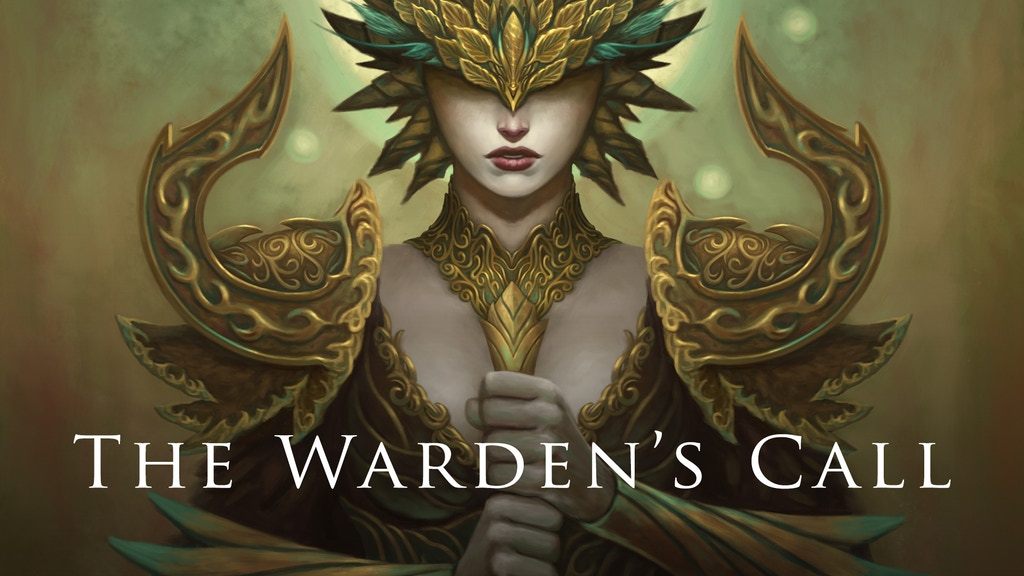
Of what I have no doubt is that Nino has an eye for aesthetics. Everything from the book’s cover to the accompanying bookmark is superbly designed—beautiful to look at and satisfying to hold. The pages of the book are stylized as parchment paper, adding to the opulent feel of the book’s linen hardcover binding and gold trim. The book also has 6×9 prints scattered throughout of all the relevant artwork that Nino had completed up to its release. And his artwork is just beautiful. It’s ornate, but not so much that I feel turned off by it. His work is closest to religious artwork in its style, which is fitting considering the subject matter of The Warden’s Call. His paintings are a bit lifeless, but I see that as a problem emblematic of the fantasy/science fiction art industry as a whole. As such, I don’t really hold it against him. If nothing else, I can safely say my purchase was worth it for just for the chance to share in Nino’s keen eye for ornate simplicity.
Even with my appreciation for Nino’s artistic skills, it’s clear to me that he needs more experience in writing. While The Warden’s Call wasn’t a slog to get through, I never really felt engrossed in the world. There’s a definite structure there, and he did a good enough job in building the world and its rules. But the presentation is where the book suffers. Most of the book is written in the style of a history book, which by its nature isn’t a very exciting format, especially considering that there isn’t a body of narrative work that something like this would normally supplement. The book does occasionally go from being a history textbook to being focused on narrative. However, these narrative sections suffer from a lack of stakes and an abundance of forced plot turns, where characters act as if there is no precedent to their current situation, and there’s no such thing as consequences. I can only describe it as juvenile, though I have a feeling that the Vecias were less concerned with writing a compelling narrative, and more interested in tying all the strings of his world together. Still, I’m not a fan of this kind of back and forth writing style. I would have rather the book be purely expository, or fully focused on narrative.
In fact, I find myself wishing The Warden’s Call had been only expository, as its narrative sections were not an enjoyable experience to read, with too many characters to keep track of—almost all of them one-dimensional—and filled with overdone tropes I’ve seen countless times before. I never found myself caring for any of the characters or their struggles, possibly with the exception of Mavus and Sigen. All the humans in the book feel inconsequential and child-like, while the divine beings are too monolithic and single-minded. The protagonist—Nereous—is your standard, reluctant yet powerful, male fantasy hero. This alone made me apathetic to his story, though the lack of meaningful conflict in his life didn’t help either. I never felt like Nereous couldn’t get out of the predicament he was in, no matter how bad it got. Likewise, I never felt like he was ever conflicted about what he was doing. I don’t think I could ever discern what he felt about his situation, if anything. There’s only one narrative scene towards the end of the book where he speaks with Mavus that I actually felt like he might be able to express emotion. Arguably, there’s also the scene in which he kills Nasir, but both of these scenes are so out of place with the stoic and necessarily kind Nereous, that they make little sense to me. Without a cohesive through line for his characterization, all we have to go on is what the omnipresent lorekeeper has to say about him, and the occasional glimpse into his life through narrative sequences. Ultimately, his role in the story doesn’t feel like it matters, and I could easily have seen him cut out entirely.
I have some issues with The Warden’s Call, but I can’t say that I regret my purchase. I realized pretty early on what the Vecias were trying to accomplish with The Warden’s Call. Its purpose is simply to weave a tapestry for the world of the Shadows of Aydralem. I still wish the narrative and overall plot was better written, but I understand what he was going for. I think it also helps that I didn’t really have any expectations for the book. Rather, I was drawn by Nino’s art style and the aesthetic surrounding the book. In that regard, I am not disappointed, and I think sometimes it’s okay to enjoy a reading experience for what it represents and for the experience of it, rather than for the contents. Still, I look forward to seeing what else Nino creates, and I hope to be able to meet him again.
Select a result to preview