


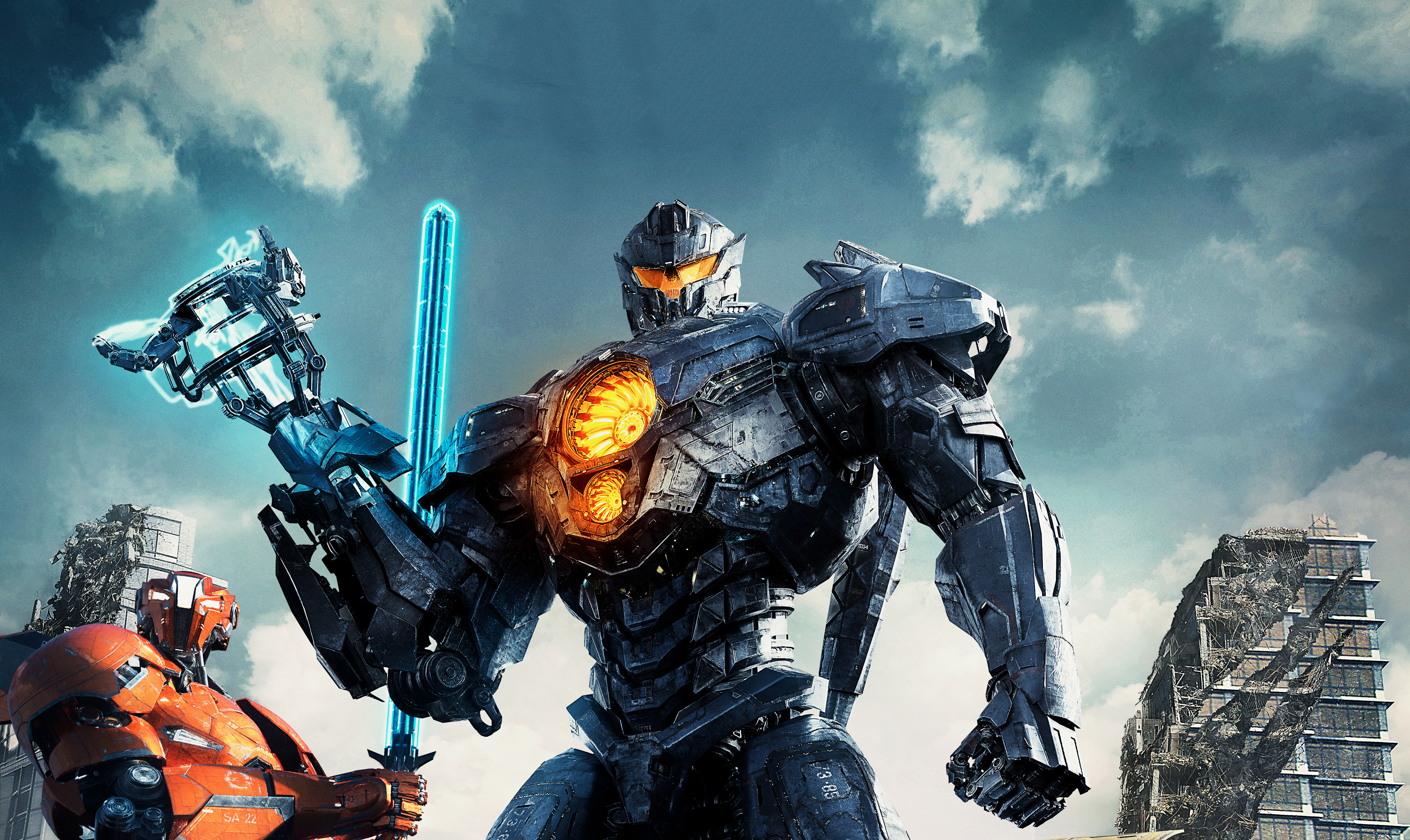
Directed by Steven s. DeKnight
2018, Universal Pictures
1 hour, 51 minutes
Rating: ★★★☆☆
Following my initial viewing of Pacific Rim, I had a lot of questions. It felt like the film was directly inspired by Japanese mecha and anime, which seemed strange to me at the time. After some research, I found out that Guillermo del Toro had explicitly set out to emulate Japanese culture films when he joined production. He wanted to bring the giant monster and mecha genres to a new level, while introducing them to a new generation of children. I was also able to confirm my suspicions that he had sought out GLaDOS’ voice actress—Ellen McLain—to be the voice of the computer for the jaegers. All that to say that Pacific Rim had been an enjoyable experience for me, helped in part to its inherit geekiness. The movie held my interest for a long time, with its larger-than-life characters, and killer soundtrack. Pacific Rim Uprising upholds the legacy of the original, perhaps even surpassing it in its homage to geek culture. In contrast to the original though, the characters can feel a bit one-dimensional and some of the plot points don’t really make sense. But, I had a good time with Uprising anyway, as it is inherently wholesome and honest.
A recent trend I’ve noticed in movies is the use of the same quippy dialogue that is iconic of the MCU. Uprising is guilty of this as well, though thankfully DeKnight manages to keep his character interactions wholesome and honest—for the most part. Character conversations tend to feel forced, as characters seem driven by their egos rather by any kind of personality. There’s really only one or two genuinely human interactions, and I think they can be attributed to John Boyega’s performance. These scenes actually felt out of place when compared to the rest of the movie, as they were heartfelt and the characters finally felt well-rounded. For the majority of the film, characters only act to move the plot forward or to force conflict. While the characters from the original Pacific Rim were not perfect, they had personality. Sure, they were over-the-top and a tad unrealistic, but they had presence. I can barely remember half the characters in Uprising due to how bland and one-dimensional they are.
It’s apparent that DeKnight and the creative team behind Uprising really wanted to embody the soul of Asian culture when writing the film. However—while I enjoyed the themes—the plot left me with more questions than answers. The twist was enjoyable enough, but many of the minor plot points were nonsensical:
Normally, I’m okay with some ambiguity in the plot. When things are left ambiguous, the audience is allowed to fill in the gaps themselves, leading to a different experience for every person. But there are just so many questions left unanswered, and all of them were initially posed by the movie as if they were integral to the plot. By not answering these questions, Uprising seems to say: “Oh, that’s not important. Just ignore that.” And since these questions make up the majority of the intrigue for the film, it makes it difficult to take any of it seriously.
My opinion of Pacific Rim: Uprising is incredibly biased. The appeal of the movie lies in its wholesome and honest writing. It allows me to overlook a lot of issues and to avoid comparing it to the first movie. In addition to its flat characters and lazy plot, Uprising has some scenes with questionable cinematography—such as the montage to rebuild the jaegers—and the music is not as memorable as the first movie. I now understand why Uprising did not do as well in theatres, and why it took me so long to get around watching it. It’s not something I would go out of my way to watch, but I had a good time when I eventually did get around to seeing it.
Select a result to preview