


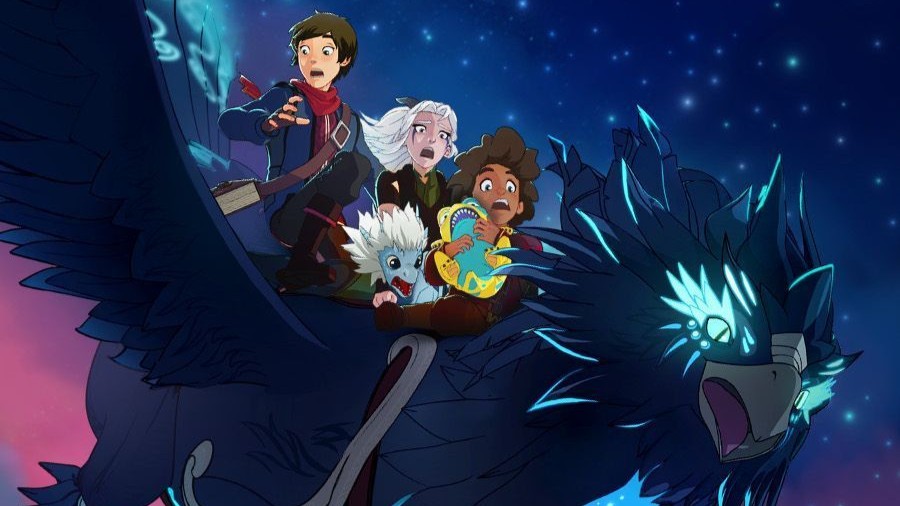
Created by Aaron Ehasz, Justin Richmond
2019, Netflix
9 episodes, 25-27 minutes
Rating: ★★★★★
It doesn’t feel that long since I reviewed the first season of The Dragon Prince. Really, I only have myself to blame, as I waited so long to begin watching it. In contrast, I devoured the second season within a handful of days of it being available on Netflix. The characters are what drove me to come back, even though I had had some issues with pacing and tone shifts in the first season. And I can easily say that I was not disappointed. The writers were somehow able to improve characterization and build on what was established in the first season, further fleshing out characters like Callum, Rayla, Viren, and even Ezran. The show still suffers from a couple of issues, mainly with a meandering narrative and some more annoying elements. But this season is a noticeable improvement over the first and shows the potential for the remaining run of the show.
First I want to address the animation style. I think I have become ambivalent to the style, as opposed to disliking it when I first started watching The Dragon Prince at the end of last year. I don’t know if I’ve just gotten used to the style or if the animation has improved, but I didn’t feel as bothered by it. I did notice the animators experimenting and utilizing the medium more effectively, but not enough for me to say for certain there’s an improvement. I’d even say the animators may have pushed the boundaries of the show’s animation too far at times, such as in the scene in the first episode where Claudia floats with heart eyes towards Zym, breaking the show’s established animation rules in the process. I think this was a bit too much, and there were more interesting ways for her to show her endearment than going full on anime tropes. The last thing I want to see is the show going from stiff and bland animation, to being filled with anime tropes. After all, Avatar: The Last Airbender was heavily influenced by anime, but very rarely relied on anime tropes. Even when it did, it fit within the style and tone established early in the show.
I think it’s easy to compare The Dragon Prince and Avatar: The Last Airbender, and then concluding that Avatar is better off. But if you were to look back at only the first season of Avatar, it had its own problems with tone, pacing and animation—which all get resolved in later seasons. Thankfully, it feels as though The Dragon Prince is following suit, showing a significant improvement overall from the first season as it figures out what it wants to be. However, there is still room for improvement. I think Zym—the titular Dragon Prince—may have replaced Ezran as the most annoying character in the show, since the writers decided the best way to make Zym likeable is for him to act like a slightly-more-intelligent dog, which I just find insulting at worst, and annoying at best. I don’t know what kind of characterization I would find more appropriate for Zym. It’s not like I expect an infant creature to hatch and then start quoting Shakespeare. Maybe it’s just the sounds they’ve chosen to give Zym that annoy me. I found myself cringing whenever he would yip or yelp, breaking my immersion as I realized how the writers were artificially trying to make Zym more dog-like. There are some hints at the end of the season that Zym may become more mature in the near future, but I have my doubts.
Conversely, an aspect of The Dragon Prince that has greatly improved is its pacing, and the overall narrative structure of the story. Everything felt much more focused this time around, with fewer distractions or misadventures that do little else beyond connecting two plot points. Everything feels like it has a place in the narrative, even if it’s just for the fun of it. Though, I can’t help but feel that the narrative meanders a bit still, as we move back and forth between Viren’s quest to unite the kingdoms and The Dragon Prince crew’s journey. But I have a difficult time pointing out any specific set of scenes that could be cut out completely. Almost everything feels necessary to the development of the narrative. We need the time with Viren and his telling of Queen Sarai’s death, just as much as we need the time spent with Callum trying to unlock a connection to the Sky Primal Source. I just felt like if The Dragon Prince were a novel or short story, I would have been left just as unsatisfied, but I could have more easily picked out the problem. But The Dragon Prince is a television series—as strange as it is to refer to Netflix series as television—so it’s easier to forgive these kinds of issues when you know more is coming. If I was to criticize anything, it’s that the seasons are too short. I didn’t think this was the case in the first season—since it spends a lot more time dawdling about—but it’s clear to me that the richness of The Dragon Prince’s world deserves more time, and nine thirty-minute episodes is just not enough time for proper worldbuilding. That, or the writers should have spent more time in the first season developing the world, and less time on hijinks. In any case, I think this season strikes as good a balance as we’re going to get between a compelling narrative structure and in-depth worldbuilding, though I can still hope that the next season somehow tightens up the narrative even further.
My primary reason for returning to The Dragon Prince was the characters, and I was pleased to see that character development and characterization remained consistently superb. I often found myself deeply invested in each character’s journey, since everyone acts like a real person, approaching situations in a logical manner. I very rarely felt as though characters were acting to move the plot forward—which is a nice change from the first season, where it sometimes felt like characters were acting out of turn to do just that. Romantic subplots are especially well done in this season, building on character interactions from the first season in subtle ways. Both romance subplots feel like natural extensions of each character’s interaction with each other, while avoiding the use of a tropey love triangle to artificially create drama. This mature take on relationships is refreshing, like in the build-up and eventual fall of Callum and Claudia’s romance, which left me wondering whether Claudia ever really cared for Callum. But the highlight had to be Rayla’s almost-confession to Callum. I can’t say that I saw it coming—again, the writers built it up in a very subtle way—but I did have my suspicions a romance plot between the two would be explored at some point. Despite my anticipation, I am so far not disappointed in how it’s being handled, and I’m excited to see their affections develop further. I’ve also seen a substantial amount of fans embrace the pairing following the season’s original air date, so I am not alone in thinking the two would make a great couple.
The second season of The Dragon Prince is a great improvement over the first. Narrative structure is tighter, with fewer distractions from the main plot, though it does feel like the writers are trying to pack too much into nine episodes. As always, character writing is the show’s greatest strength, easily carrying to show forward and making me invested enough to want more in the third season. The writers have shown themselves to be able to present genuine, honest character interactions that are engaging, yet subtle, trusting the audience and rewarding active viewing. There’s a lot to live up to in the next season, but I now have faith that the writers and animators behind The Dragon Prince are up to the task.
Select a result to preview