


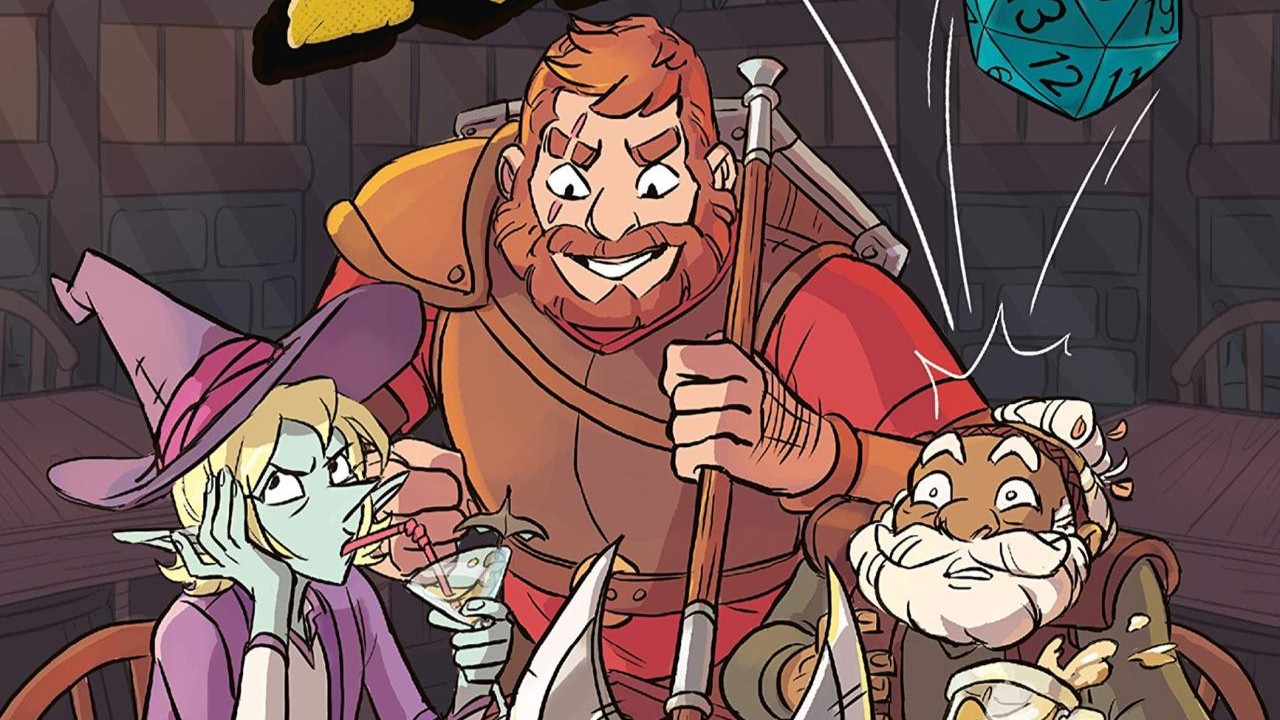
by Clint McElroy, Justin McElroy, Travis McElroy, Carey Pietsch
2018, First Second Books
Paperback, 239 pages, $25.99 CAD
Rating: ★★★★☆
The Adventure Zone is something I put off too long before really getting into. I had experienced bits and pieces of it over the years in the form of fan animations or fan art, but I didn’t think the podcast itself would be for me. My podcast interest at the time was limited to political or philosophy talk shows, and I have never really gotten into live play tabletop shows. I always found them a little too cringy and reliant on tropes. It’s only because my new job gave me space to explore new podcasts that I decided to give The Adventure Zone a shot (I spend a lot of time on my own, doing repetitive tasks.) And to quote the preface by Pat Rothfuss:
[…] The Adventure Zone is some of the finest storytelling I have ever experienced. In any genre. Ever.
I don’t really have a better way of summing up the podcast than this statement. It’s surprising how good The Adventure Zone is when you consider that the majority of the story is improvised and left to the whims of the players. Griffin McElroy has control over the overarching narrative, but much of the moment-by-moment drama is left up to his brothers: Justin McElroy and Travis McElroy, and their father: Clint McElroy. Character interactions, development, and dialogue are left up to the player characters, while Griffin—as the dungeon master—limits himself to shaping the world and the overarching narrative, along with a few interesting NPCs in the mix. However, there are some issues specific to the medium that detract from the storytelling experience, such as:
It’s sometimes difficult to know for sure if these issues are intentional consequences for what the McElroys intend for The Adventure Zone, or if they result from a lack of experience. Either way, these issues are never severe enough to turn me off the podcast, and I believe the McElroys have achieved something rarely seen in our time: a story built from nothing and without intent, born whole cloth from the hearts and minds of those involved in its creation. Too often, creative works feel manufactured to be consumed—such is not the case with The Adventure Zone.
_The Adventure Zone: Here There Be Gerblins* is an adaptation of the first arc in the Balance campaign of The Adventure Zone podcast, and it has inherited many of the qualities and issues of its source material. While I can imagine someone may be able to pick up Here There Be Gerblins without any context of what The Adventure Zone is, there are a lot of jokes and references that may be lost on anyone who isn’t familiar with Dungeons & Dragons or The Adventure Zone. But, none of these issues were enough to significantly lower my opinion of the graphic novel, and I have already read it from cover to cover in one sitting—twice. To help me categorize my thoughts on Here There Be Gerblins and The Adventure Zone as a whole, I’m going to break down the different levels that make up the podcast and contribute to its success:
These levels all contribute in their own way to the success of The Adventure Zone, but I think the most important is the narrative level. Whenever I saw fan art or fan animations, they were born out of a love of the characters and their interactions more than anything else. That isn’t to say the other levels are not enjoyable on their own—I just don’t think they have the same lasting impact as the narrative. When I first heard of Here There Be Gerblins. I expected that it would be exclusively made up of the narrative level, disregarding the other levels in the process. I was surprised, then, that Clint and Carey Pietsch decided to include various elements from the other levels, notably some from the game and goofs levels. In some ways, these inclusions work, but mostly I think they detract from the experience as they break immersion and the internal world logic set within the first few pages.
At first, I found the inclusion of Griffin the Dungeon Master as a character awkward and forced. Merle, Taako, and Magnus seem to accept his existence without much questioning, and he doesn’t really fit in with the internal logic of the world. He also serves as little more than a vehicle for jokes, usually themed around Dungeons & Dragons. It’s a shame because he does have some good moments when he’s actually part of the narrative, acting as a narrator of sorts rather than as a dungeon master.
Most references to the fact that the McElroys are playing a game of Dungeons & Dragons were awkward and unnecessary. Some were genuinely funny and fit the tone of the graphic novel, but these were few and far in between: Merle studying cantrips, Magnus trying to decide what weapon to use, Taako having a timer on his charm spell—these all reference Dungeons & Dragons, while still making sense within the world established within the first few pages. But whenever characters make references to dice rolls, spell slots, or hit points, my immersion is immediately broken.
It wouldn’t be so bad except that none of the characters ever acknowledge what it is they are referencing. The fourth wall is never broken—it’s felt up and rubbed up against, but none of the characters ever outright say “We are characters in a game of Dungeons & Dragons.” This wasn’t a problem for the podcast, since we had the players discussing the game on the meta level. They were there to acknowledge inconsistencies and quirks specific to playing tabletop games, as well as to explain why characters would suddenly speak to NPCs about spell slots or hit points. But that is missing here, and it just made me feel awkward whenever it happened. I can only imagine how it must be for people who read Here There Be Gerblins with no concept of tabletop gaming or the source material. It would seem strange that these characters are talking as if they’re in a game, without any explanation why.
I’m not really a pop culture kind of person. Whenever I watch a movie or listen to a podcast which relies solely on pop culture references, I quickly get lost in the weeds. If the work has other merits and the pop culture references are just flavour, I can usually get past them to appreciate it for what it is. But if a piece of entertainment relies solely on pop culture, I can’t really follow along and quickly turn off. Whether it be The Adventure Zone or My Brother, My Brother and Me, the McElroy’s make a lot of pop culture references. But they make up for it with their delivery and their other forms of comedy. Even if I don’t know who Tom Bodett is, I can appreciate that an entire town is populated with this one celebrity, and how funny the rest of the family thinks this is.
While I can take these pop culture references in stride when listening to the podcast, it’s not as easy to do when reading the graphic novel. There isn’t any supplementary comedy to support the reference, and delivery is based entirely on how quickly the reader can read and process the information. A good example of this is when Griffin attempts to describe Barry Bluejeans’ appearance using celebrities at the beginning of the second chapter. There is something inherently funny about morphing two faces together to create a new face, but I don’t really care about these celebrities. Instead of finding the joke funny or appreciating the reference, I told myself “Oh, alright.” and moved on. Nothing was added with the reference, and I think moments like these actually kill the pacing of the narrative. I remember the same scene being funny in the podcast, but there we had everyone’s reaction to the joke to supplement it. That is missing here, and so I couldn’t enjoy it for what it was. Pretty much all the pop culture references in Here There Be Gerblins felt the same to me.
There isn’t much in terms of meta content in the graphic novel beyond what’s already embedded in elements from the game and goofs levels. In Here There Be Gerblins. only Griffin exists as a character, while Justin, Clint, and Travis do not. So most of the meta elements come from Griffin as he alludes to—but never outright confirms—the fiction that is The Adventure Zone.
As The Adventure Zone grew, it quickly became apparent that the fans were an important part of the experience for the McElroys. Every episode has callouts to the fans, letting them know their involvement with the show is appreciated, and The The Adventure Zone Zone episodes are a chance for the McElroys to address fans directly and discuss their creation with them. As such, branding, running jokes, and fan-favourites have also become important to the world the McElroys have built over three years. For the most part, they have kept the main storyline free of brand influence. Characters make decisions based on their motivations and individual personalities, not based on what the fans would prefer. But when it comes to live shows, all bets are off. Inserts, cameos, and fan service are rife throughout the show, easily being the highlight of every panel as the fans cheer with every appearance of Angus or Garyl.
_Here There Be Gerblins* lands somewhere in the middle, with some changes to the narrative being references to what The Adventure Zone is today, instead of what it was when it first started. Some examples include:
I feel these changes we mostly made in response to fan expectations rather for narrative purposes, since these elements are already core to what The Adventure Zone is to many fans. These changes did break my immersion when they occurred, since I was immediately aware that a change was made, but I think that’s more my problem than any real criticism on the quality of the graphic novel.
As previously mentioned, I personally expected that the graphic novel adaptation of The Adventure Zone would focus solely on its narrative. While this was not the case, The Adventure Zone: Here There Be Gerblins is still an excellent graphic novel, due in part to the great job Clint and Carey did in adapting the podcast to print. Whenever something is adapted to another medium, there’s always a trade-off of sorts. Apart from The Hitchhiker’s Guide to the Galaxy, I don’t think I’ve read any other audio drama adapted to print before. And just like Douglas Adams’ adaptation of his own radio drama, Here There Be Gerblins manages to not only adapt The Adventure Zone’s first arc perfectly, but does it in a way that delivers a great experience for fans and newcomers alike. However, that trade off is still there, and it shows up in ways I didn’t think were necessary.
One such change is with names. It makes sense in retrospect, but I was confused at first when Klarg was introduced as G’nash. I knew who the character was, but the name was foreign to me, leaving me confused. It nagged at me until I learned that the name needed to be changed as Klarg was trademarked under Wizards of the Coast. Once I realized this, I realized a lot of other names—mostly place names—had been changed. I was initially upset about the decision to change beloved character names, but I understand why it had to be done. I’m sure the McElroys were equally disappointed when they learned they could not use the names fans had become used to. In a perfect world, I wish the original names could have been kept. As an aside, since they had to change names, I wish they had also updated Magic Brian and Bryan’s names. A complete change wouldn’t be necessary, but their names really stand out as silly when compared to everything else, especially with updates made to existing characters. It makes Magic Brian feel like the throwaway villain that he is, even though he will eventually show up at least two more times in future arcs.
Magic Brian is, of course, an artifact of the carefree approach the McElroys took when they first began The Adventure Zone. Another significant issue to come out of the podcast’s humble beginning is its initially haphazard pacing. In the beginning, the McElroys were just having fun and goofing around, without any kind of plan to make The Adventure Zone what it is today. Unfortunately, this haphazard pacing has bled over into the graphic novel, as events ebb and flow erratically instead of following a logical narrative structure. It’s not until after Magic Brian’s death that we get a sense of purpose, a goal for the trio to follow. I’d like to think this problem stems from the humble beginnings of the podcast, and we’ll see an improvement in the next volume.
I just have two more grievances to address. Firstly, I found the character introduction visual gags silly and superfluous—especially when used multiple times for the same character as a joke. I find comic book tropes like this lazy from a worldbuilding standpoint. Characters should be introduced organically through conversation or exposition, not flavour text. It becomes more evident how weak these introductions are when you compare them to the way Carey and Clint handled the voidfish memory erasure plot. They trust the reader with the mystery, have the characters organically react to the phenomena and then trust the reader will be able to intuit what’s going on without having it slapped in their faces. Griffin doesn’t show up to explain the voidfish, and there isn’t a long dissertation on what happened. Everything is shown, not told.
Finally, I’m not a fan of Barry being the one who sets off Bogard Stoneseeker (Gundren Rockseeker) near the end of chapter nine. It feels out of character for Barry, and I think any other character could have been the one to drive Bogard over the edge if the orc Kurtze would not be the one to do it. I don’t really know why this change was made since Barry dies either way.
In spite of these issues, Here There Be Gerblins has many of the same qualities as its source material, and even manages to improve on some things. Humour is something that carried over well from the podcast, specifically in the form of character comedy. Taako, Merle, and Magnus are as hilarious and rich as they are when played, respectively, by Justin, Clint, and Travis. NPCs feel even more fleshed out than their podcast counterparts. Not that Griffin didn’t do a good job the first time around, but his focus was more on driving the plot forward, while his brothers and father only had the development of their own character to worry about. The extra time Clint and Carey put into the setting, characters, and situations help to accentuate what made the story great in the first place, while adding expressions, gestures, and physical comedy that weren’t present in the podcast. Chapter four made me laugh out loud, since they were able to take a throwaway line and turn it into a one-page travel montage that makes up the entire chapter. To me, these kinds of changes are a welcome addition, as they play with the medium and improve on the what’s already there, instead of trying to recapture jokes from the podcast that don’t necessarily translate well to paper.
Killian is a fantastic example of how to flesh out a character when adapting them for a new medium. Clint and Carey gave Killian the respect she deserved in Here There Be Gerblins. treating her as a full-fledged character, on the same footing as Merle, Taako, and Magnus. I particularly enjoyed her expressions and the way she interacts with the main cast. The denouement of Here There Be Gerblins has some of my favourite moments in the whole graphic novel as Killian interacts with the main cast in hilarious ways. She also signifies the first attempt at representation in the podcast, though Merle and Lucretia’s character designs also help to reinforce the McElroys’ desire to be inclusive. I know there’s some controversy over how the McElroys have traditionally handled representation, but to me, these are some steps in the right direction.
Most of all, I think it’s important to really bring home how good the writing is. Characters speak like they did when played by their respective actors, and very rarely is new dialogue written for them. When it is, it fits the personality of that character perfectly. Also, a lot of the quirks that come with producing a live play podcast are circumvented in _Here There Be Gerblins*. such as time spent discussing game mechanics, looking for spells or speaking to the dungeon master. One of the biggest criticisms I had when I began listening to The Adventure Zone was how it felt like Griffin was forcing his brothers and father down a specific path, taking away their player agency in the process. I’ve come to realize a few things though:
The Adventure Zone is less a game of Dungeons & Dragons and more of an improvised radio drama, wherein only the narrator—Griffin—knows the outcome of the story, and the actors—Justin, Travis, and Clint—are required to play it out. Once I accepted this was the case, I enjoyed The Adventure Zone a lot more for what it was. Here There Be Gerblins completely sidesteps this issue, since it is fabricated with no other purpose than to tell a story. So, the narrative must inevitable go in one direction, with the Dungeons & Dragons fat trimmed to streamline the story. For this reason alone, I’m excited to see what Clint and Carey do with Murder on the Rockport Express and the arcs to follow, since they mark when the McElroys began seriously considering The Adventure Zone as a piece of dramatic entertainment instead of a live play podcast.
I don’t know if I can recommend The Adventure Zone: Here There Be Gerblins to people uninitiated to The Adventure Zone or Dungeons & Dragons. There are too many callbacks and references without explicit explanation that may leave some readers confused or turned off completely. At the same time, I think that the story of Taako, Merle, and Magnus is sweet, funny, and endearing enough on its own for anyone to enjoy. Things will also undoubtedly get better from here, as the narrative becomes more streamlined in upcoming arcs. Also, Carey’s art and panel composition is top-notch. Her expressions are stellar, her character designs are consistent throughout, and I never felt lost due to bad panel composition or unclear art direction. I will be coming back to her work as inspiration on how to make my own graphic novels in the future, and I will be keeping an eye out for the next volumes in this series—no matter how long it takes for them to come out.
Select a result to preview