


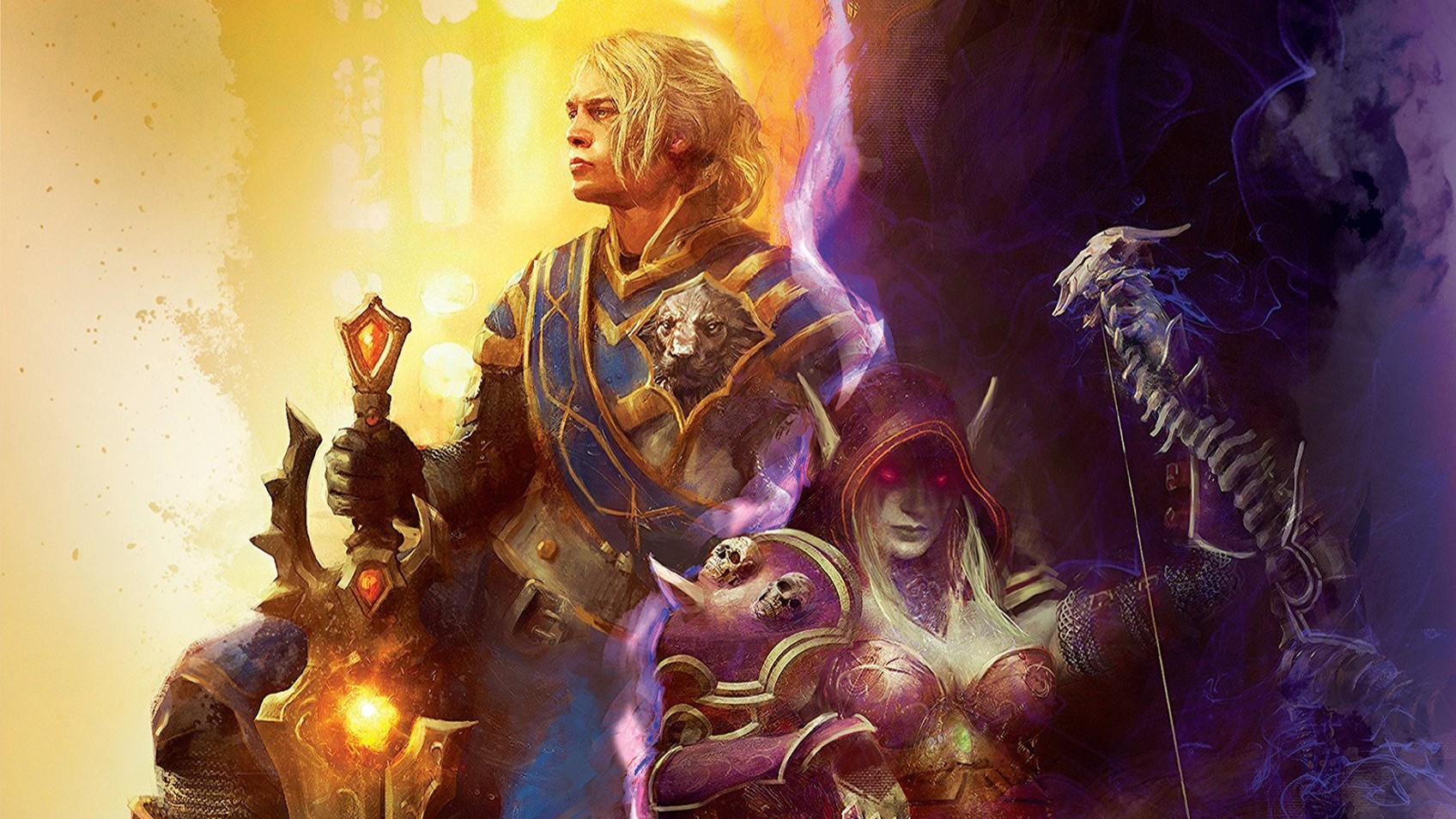
by Christie Golden
2018, Penguin Random House
Hardcover, 287 pages, $37.00 CAD
Rating: ★★★★★
It’s impressive how consistently entertaining Christie Golden’s tie-in novels are. I have read almost every Warcraft tie-in novel, and she remains my favourite author throughout. Some of her works can be a little dull, but even so, they are still competent. The same can’t be said for other writers who contribute to Warcraft lore. It seems Blizzard is realizing this as well, as Golden has more writing credits than any of the other writers, and has even been part of the writing team for cinematics. She is a true fan of the world and of the vision heralded by Chris Metzen and so many others. This passion continues to show in World of Warcraft: Before the Storm as Golden is once again tasked with transitioning between expansions, while simultaneously building on top of what we already know and love. I could expect nothing else, though I do have some issues. I experienced a disconnect with the hopeful nature of the Forsaken, and I felt as though the novel could have benefited from more worldbuilding. However, these issues are minor and shouldn’t take away from the experience Before the Storm delivers.
I love geek culture, but one thing I’ve always struggled with is how worldbuilding can alienate the audience if the writers don’t take the time to flesh things out. The easiest example I can think of is the Death Star from Star Wars. If you had to explain to someone what the Death Star is, you’d most likely feel foolish and have a difficult time detailing what a giant moon-shaped super weapon is, and how it is important to the story, and so on. But since the Star Wars films do a good job of using the Death Star, most audiences accept the Death Star as it is. This is sadly not the case with some elements in Before the Storm. such as the Netherlight Temple. Maybe it’s because it’s a rather recent addition to the world—or because it is an area that was created for gameplay reasons—but whenever Anduin travels to the temple, it just felt awkward. Other locations like Stormwind, Orgrimmar, and Arathi Highlands, felt grounded, realistic. I’ve personally spent more time in these locations, so I may be biased. But when it comes to the Netherlight Temple, it just doesn’t feel like a real place. Anduin cannot travel there by foot or vehicle. He has to be magically transported to a place outside of time and space. It just feels underdeveloped. There are a few other examples of this, such as the use of hearthstones and portals, or the inclusion of nightsaber mounts that act like horses. I understand that Golden is not tasked with worldbuilding and that these tie-in novels are meant to supplement the world, not describe it. However, I can’t help but feel awkward when reading these kinds of passages. It breaks my immersion and makes me realize these tie-in novels are more akin to fanfiction than literature. But maybe it’s just me. It’s not as if I personally need to explain what the Netherlight Temple is to someone, or the science behind a hearthstone, or the reason why a portal makes sense. It makes sense within the context of the world of Azeroth, and that should be enough. And yet I can’t shake the feeling that if Golden was allowed the space to flesh out these elements, she could elevate Before the Storm and similar novels to a new level. She has already mastered characters and narrative—improving worldbuilding would only better the experience.
Another of Golden’s works I thoroughly enjoyed was Warcraft: Rise of the Horde, as it was one of the first instances in the Warcraft universe to paint the orcs as an actual people. They were no longer demons from hell, but a living, thriving people with culture and a history. As time went on, the orcs were fleshed out further and given more history with the Warlords of Draenor expansion. But it was Golden who made us believe the orcs were more than savages—that they were a noble, primitive race forced to progress before their time. Something similar was attempted in Before the Storm. Up until now, we’ve been led to believe that the Forsaken were the Scourge, but not. The undead of the Undercity seem to follow Sylvanas with an unnerving loyalty. They are generally either bitter or cruel towards life. They live in squalor, among the dead, and in unclean conditions. When listening to non-player characters in the Undercity and other Forsaken settlements, all they speak about is ways to undermine life. It’s clear that Blizzard has built up the Forsaken as shadows of what they once were, devoted to their Banshee Queen and to the destruction of life. And so I could not help but agree with Sylvanas when she expressed that the majority of the people would not want to reconcile with the living. Golden spends some time building up believable Forsaken characters who genuinely want to reunite with their living loved ones. I don’t think anyone could have done it better, but I didn’t see these characters as Forsaken in the way I’ve come to know them in World of Warcraft. It felt as though this new side of the Forsaken was being forced down our throats for the purpose of plot, and not a true extension of what the Forsaken are. They are a bitter, desolate people who have lost everything to become something monstrous against their will. While this doesn’t mean they have to be evil—I myself have built Forsaken characters that have accepted their new life without becoming monsters—it seems unreasonable that a good portion of the population would suddenly become adorable, misunderstood zombies who just want to be loved. Perhaps these themes will be explored further in the upcoming expansion. We will have to see.
As I’ve mentioned previously in this review, Golden excels at character building. Anduin feels fleshed out and real, as do most of the characters. When Turalyon has a change of opinion regarding the undead, it feels earned and true to his character. When Saffy falls for her estranged ex-husband, it doesn’t feel forced or unrealistic. It truly feels as though these are people living in a strange, magical world. They are amazed by the unfamiliar, but most of it is mundane to them. Golden rarely—if ever—focuses on the strangeness of events or of an object. The focus is always on the characters and how it affects them. This allows us as the reader to become invested in these characters as they drive the narrative forward, ensuring our immersion in the story. And the narrative is another aspect which shines in Before the Storm. I was on the edge of my seat until the very end because I was invested in Anduin, Catia, Sylvanas, Saffy, and the myriad of Forsaken characters. I knew more-or-less how the story would end—Blizzard has not kept the events of Battle for Azeroth a secret. However, what was important was how it would end. In that, I was a little disappointed, but I can hardly fault Golden for that. It’s likely the Blizzard writing team already had a map drawn with point A and point B, and Golden was tasked with drawing the line between the two. With that in mind, Golden masterfully kept me invested from beginning to end, even if the conclusion left me wanting.
_World of Warcraft: Before the Storm* showcases the best that Warcraft can offer in terms of storytelling, all thanks to Golden’s talent for narrative and character building. Once the story began in earnest, I had a difficult time putting the book down. With familiar characters like Anduin and Sylvanas, it was interesting to see how they would influence the story and move through these experiences. For new characters such as Saffy or Elsie, I was deeply invested in their own stories, excited to see what trials Golden would put them through. I can’t recommend this book enough if you’re a fan of Warcraft, though I’d be hard-pressed to suggest this to the uninitiated. It suffers from a lack of worldbuilding, and relies on the reader having some prior knowledge of the world. I also hope that this is not the last instance of Forsaken hoping to reunite with the living, as it would make the characterization Golden did here meaningless. Regardless, I eagerly await the next novel from Golden and will be reading the two novellas that came with the collector’s edition shortly: Elegy and A Good War.
Select a result to preview