


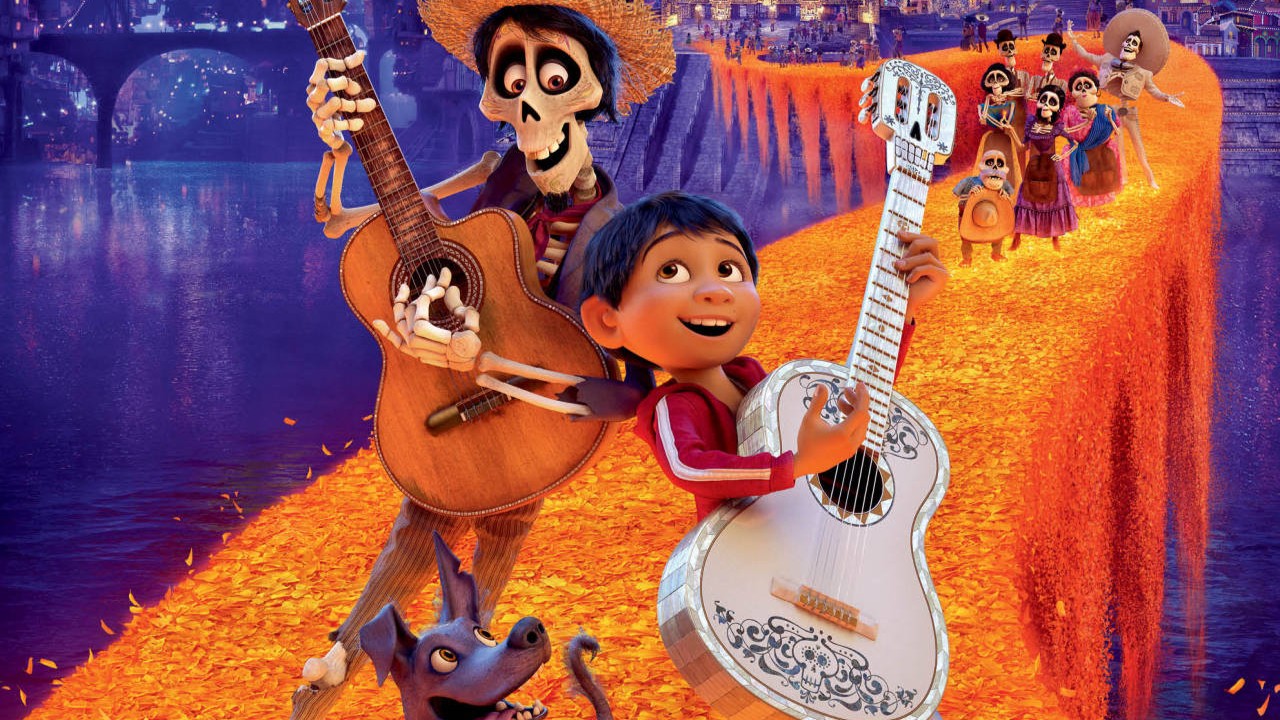
Directed by Lee Unkrich, Adrian Molina
2017, Pixar Animation Studios
1 hour, 45 minutes
Rating: ★★☆☆☆
I hate to admit it, but Pixar seems to be on the decline recently. Their last film I can really remember enjoying is Inside Out, and even that pales in comparison to Up or WALL-E. I can’t say to what the cause of this drop in quality is, but Coco does not show promise for the future of Pixar. Released amidst a string of sequels that began in 2016, Coco is a fun but ultimately forgettable film that is strangely unoriginal for a Pixar film. Characters are one-dimensional, pacing is slow, and the story is wholly predictable. Visuals are impressive, but every major motion picture animation studio can claim this prize. What always set Pixar apart was its focus on visual storytelling and emotive characters. Sadly, Coco does not embody either.
While simple in its premise, I found myself invested in the story up until the final act of the film. I can attribute my interest in the narrative to my own experiences as a child. I had interests which were considered abnormal by my family and peers, which made it difficult for me to immerse myself in my hobbies. Miguel has similar issues in Coco. His actions are a little exaggerated at times, but I can understand his desire to pursue music in the way that he does. It was also clear halfway through the movie that de la Cruz was going to be true villain and that Miguel’s family was just a roadblock. However, I was genuinely surprised when it turned out that Héctor was Miguel’s ancestor. Their relationship had seemed nonsensical until their familial connection was revealed, so Héctor being Miguel’s music-loving great-great-grandfather brought some much-needed value to their interactions. I do not think the revelation was handled well emotionally, though that is an issue pervasive throughout the film.
Miguel acts like a child should act: impulsive, reckless, and naïve, driven by his immediate desires. His actions in the film make sense, for the most part, and when he overreacts, it feels genuine. By comparison, every other character is comical and underdeveloped, defined by one or two character traits. It’s clear that every character was placed in the story to support Miguel, making any changes these characters go through feel shallow and unearned. This lack of character development becomes clear with the reveal that Héctor is Miguel’s disgraced ancestor. Héctor has a complete turn around in personality from his previously established character, becoming much more understanding and caring than he was previously. As evidenced by his mannerisms in the first half of the film, Héctor was actually accustomed to his life in the afterworld. He may not have been happy, but he had settled into his life with the other disgraced souls, living apart from his estranged wife and descendants. It also seems he had either forgiven de la Cruz or given up on pursuing any actions against his partner, again evidenced by his apathetic response to Miguel regarding de la Cruz.
Héctor is vibrant and has a roguelike charisma throughout the first half of the film and is obsessed with returning to the living world. In the final act, he is completely different. He is sombre, goofy, and loving. He suddenly cares for Miguel and his wife, despite the fact that he has had at least three generations to reconcile with her. He expresses growing love for his daughter Coco, having only mentioned her in passing before. As the audience, we’re supposed to believe that Miguel being revealed as Héctor’s great-grandson is the catalyst for this change. In reality Héctor changed because Miguel’s story arc demanded it. Miguel needed something new to chase to prove that he cares for his family just as much if not more than music. And thus begins an unnecessary plot to bring Héctor’s photo to the living world. It is unnecessary because:
The photo McGuffin seems like an excuse to have one final showdown with de la Cruz, defaming him in the process. The conclusion of the film also feels a bit contrived in this regard. I find it hard to believe that de la Cruz’ ridiculously zealous fan base would discard him overnight over some letters a random old lady held onto for nearly a hundred years. We have celebrities—alive and dead—constantly being called out for grossly inappropriate behaviour, but somehow still being defended by a large population of rabid fans. De la Cruz’ comeupins felt unnecessary to the development of Miguel’s character, which was the sole focus on the film throughout. It detracted from the message Coco was trying to tell—that you can do what you love, while also caring for your family at the same time. Though, ultimately I don’t think the film succeeds at conveying this message in any way. There are also some hints that Coco wanted to convey that you should trust your family and support them when they want to do something new, though this wasn’t fully developed either.
I don’t think I can conclude this review without comparing Coco to The Book of Life, a 2014 film from 20th Century Fox and Reel FX Animation with essentially the same themes as Coco. I won’t go into the controversies surrounding the two films, but suffice to say that since Coco was released three years after The Book of Life, it appears as though Coco may have been directly inspired by The Book of Life. Whether or not this is true, I cannot say. But I want to take some time to compare the two as I enjoyed The Book of Life much more than Coco, and I think it’s worth mentioning why. First of all, I appreciated the music choices in Coco more than I did in The Book of Life. I could not get over the use of I Will Wait and Creep, which seemed inconsistent with the themes of the movie. On the other hand, I think music was performed better in The Book of Life when compared to Coco. The only song that really caught my interest in Coco was Un Poco Loco whereas I can easily recall a few different musical moments from The Book of Life. And I think its focus on delivery is why I enjoyed The Book of Life more than Coco. Everything from the music to the art style to the narrative is lovingly constructed in The Book of Life to convey its themes. Coco, by comparison, is a generic family animated film with Mexican cultural flair attached to it. I love the art style in The Book of Life. It retains a colourful Mexican aesthetic while having the characters appear as puppets to reinforce the storybook feel. The characters are all well-developed and feel believable within the world. Instead of the world revolving around one character, there are three, arguably five, primary actors in The Book of Life that drive the story. Each one has their own personality that goes through a noticeable change by the end of the film.
Coco looks like a Pixar movie, but it doesn’t have the heart of one. I am a little sad to see this change in Pixar’s track record. Pixar films were always movies I could recommend to anyone—young or old. They are almost exclusively heartfelt experiences that use the medium to convey stories in ways you’d otherwise be unable to with live action film. But since the release of Cars, we have seen the slow decline of this once proud studio. The only Pixar film I have truly enjoyed since 2010 is Inside Out—that represents almost a ten-year gap since the last worthwhile film. I understand that times change, and at some point Pixar has to make money with safe ventures like Coco or Cars 3. But I can still hope that Pixar regains what it once had: a passion for making emotionally charged animated films that can be enjoyed by adults and children alike. If not, then the fact that The Book of Life was better produced tells me that other animation studios may be ready to take up the torch.
Select a result to preview